Showing posts with label Reflections. Show all posts

Tuesday, January 06, 2009

Happy New Year after A Year of Travel

P1000904-resize

2008 was a year of traveling. The images that are salient to me are of mountains, and of sitting on buses with my cheek against a window; I see myself third-person, looking at the dusty yellow road outside; I think of going home every day, walking up Giraldez in the dark, hearing dogs bark, a few internet cafes and yellow ice cream vats on the street; I think about all the nights I sat with Nilda, that beautiful girl who seemed very sad, just the two of us at the table, sipping soup; I think about waking up at dawn.

For me, thinking about 2008 is a lot like thinking about traveling. It is only a coincidence that this was also a year of travel for America. An odd coincidence: I've heard some people say that their lives are products of artistic design – I don’t think that is true. But is odd, as a point about narrative arc of some sort, that the two, my traveling and our country’s, come together that way – it is odd that I leave America at exactly the moment when so many people are rediscovering its meaning.

The history of our country is punctuated by moments when we have chosen to be better, to create a more perfect union, and it is my conviction that we are passing through one of those moments right now. And 2008, a year for me that has featured a long march in Peru and then the inundation of Harvard, a year of abyss in all the best ways, also constitutes a personal moment when I choose to be better than I have been.

Travel, though, only means something so long you stop. Why travel? I used to say: to understand your home. Well, we’ve traveled an awful lot. Let’s get to work.

Here’s to 2009. I think it’s going to be a good one.

Friday, October 19, 2007

A Very Short Love Letter to America

This small collection of pictures spans a time period from the beginning of the summer -- to me known as the Summer of Love -- to the end of my travels in the West. Though this period is rather short, I will remember it as endlessly long. How long is the moment that a ball tossed in the air stops and sits before it travels down again? There is a moment that the ball does not move. This is the moment of transition, of reflection; the ball is at once traveling up and traveling down; this is the moment that glances at infinity, that is outside of time, has no beginning, no end and is infinitely short. Therefore the moment is forever. For me, that is the feeling of this period in my life.

This was not a specific feeling, but a general one. It gripped all those closest to me. On the hottest days of the heart, it was always three o’clock in the morning, and we are waiting awake for the first light of dawn. This was a period of restlessness.

Perhaps, one might say that America herself is caught on a brink of anticipation, running without moving towards something we do not know. America (to borrow Mailer's phrase) is pregnant.

I am leaving for Latin America on Sunday, and once I leave, I doubt that I will ever be able to sufficiently restore these feelings of infinite anticipation. After I leave I doubt I will ever be able to wholly return, and perhaps I will not want to. Therefore, these photographs and memories are a last glance at my home. These are my images of America: if they die away, then a part of America for me dies too. But they are alive, and indeed it is tough to hate America looking at the Rocky Mountains. My country has certainly committed barbarities – yes, they are outrageous. But can America be truly obscene if she has produced for me these people and spaces?

Treehouse

The dirt is soft against the feet. That is how you know the trail, even in the dark – like tonight, with a full moon. The woods are wild: a cracked tree, long javelins protrude in the moonlight, fallen stones from the old wall, logs decaying to sawdust, wiry branches kiss your face like sad, chapped lips, spider webs wrap on your skin and taste like long hair in your mouth. About two-hundred yards into the trail, the cars and road are no longer visible. If you stare into the glow of the trees against the black sky it makes you think for a second that you’ll die in the woods, somewhere next to the stone wall, but that it wouldn’t be the worst end, to leave your bones among the leaves. After all, the black sky is august.

Just when these thoughts come, they go, for the awkward turn of the trail opens to the noise of the crowd, somewhere faintly away. Then, ike a phoenix, it emerges into sight; the lights strike first. They are fantastical lights. They shine in a circle. The noise, drums against the sky, strikes too. You move towards the lights and the noise. Even moths travel towards their own salvation, even if it ends up killing them, on a fire; Then they burn and dazzle. So you appeal to the animal and search in the woods; and you simultaneously are the civilization that destroys the animal with those fantastical lights. Curious how the transition between the one and another – man and his animal ancestor – is not difficult. For a moment the civilization and the woods are united. They are one for a moment. Then you move from the wild trail into the party, where your friends greet you with smiles.

Prom

Get Yo Jollies III

She glanced at me. Her face was filled with such a mixture of intimacy and vacancy that I felt guilt. Hers was the sideways, awkward glance that one can imagine between a whore and her client, after they both have dressed. “Goodbye” he says, with melancholy, shame, and satisfaction; “goodbye” I said to those eyes.

Maine

That you might think is wrong. Max did not on most occasions believe that recklessness was admirable. In fact he looked down on that dirty, moonlight class of teenagers who profited on their own wildness. Sex, fire, alcohol! Balls! All were like street chases broadcasted live – to make headlines during the evening news or to sell newspaper ads for facial cream. Recklessness, by most accounts, is not synonymous with freedom. The teenager is a servant to his own identity: he must each night bring himself closer to his own destruction if he want to continue to be alive. You cannot build anything by destroying everything. And when the onlookers tire of his antics, they tire of his life itself, caring not whether he jumps from a ledge to his own doom or whether he just stands there, bamboozled, while everyone walks away to watch the next joker play with guns.

But she was different. Wildness for her was neither statement nor identity; it was a property of her soul. She does not have to be reckless. Or have to be anything. Hence, she could take everything. Perhaps the definitive moment when a girl transitions to a woman is when she realizes that to be good is easy; and that the real challenge is to be bad – and enjoy it. Max had known girls before – yes he had know the young and the good – but woman he knew few...

Mt. Katahdin

...too smart to be destroyed by madness, but too stupid to know that there are fates much worse for great minds than ending life too early: among them, beginning life too late -- passing seamlessly from the protective womb to the protective grave, with no intervening period, and with nothing to show for it.

San Francisco

Oakland

Napa Valley

Point Reyes

...what a curious cat! too free to be a queen, but too beautiful to be a serf. A sphinx, she reclines languidly on a Moroccan rug in my mind, purrs until my heart breaks, and then at night vanishes curling like a wisp of smoke.

Jamba Juice

Aspen


Colorado College


Sunday, July 15, 2007

Ticket to Anywhere

The quick, bright shapes of the sun retreat below the horizon. We watch the retreat on a hill, while vague pinks and purples spread out into the long New York night. It smells like grass and twilight. We see the last yellow blush of the sun vanishing, imperceptibly.

On one hand, the sunset, idyllic, is of nature, spontaneous, tangible, it is everything; on the other, it is just a drabber version of what has flashed in front of my eyes many times before, either in miniature on hotel postcards or in technicolor on the screens at the cineplex.

At a greater rate than ever before, the experiences we have day-to-day are synthetic. They are the digital images and interpretative commentaries that multiply forward in geometric procession. By way of these images and commentaries , we were there to meet the suicide militant in Pakistan or to check the Nuclear reactors in North Korea. We were there, but not like sitting on the grass to watch a sunset: The event was in two dimension on our television, computer, newspaper, it was manufactured and deliberate, related but ultimately divorced from reality. Our experience was a product of human hands, designed to satisfy our appetite for the illusory and fantastic.

At least one effect of these synthetic experiences on our consciousness is that living in this world becomes more and more each day like flipping through the pages of a magazine. Everything we might see beyond our stoop self-references something that we have already “lived” through. Even our emotions: are we really angry that Sally kissed Joey after she kissed Tom? Or are we acting as we think we ought to, in line with our favorite soap opera or tabloid story. Few things are left unseen; few emotions are left unexplored. Life becomes more like a continuous rerun of forms and color, like a sunset that we’ve all seen not once, but a thousand times before, embalmed in some electronic medium, airbrushed and perfect.

For better or worse, in a world where natural novelty and surprise have all but expired, the burden to enliven our lives shifts from God and His spontaneous will to mankind itself – to the cinematographers and studio executives who we expect nightly to channel into our humdrum living rooms the extraordinary. We are the merchants of our own illusions, who must sieze for ourselves what is worthy. In a world of reruns, no price is too high for a new sensation.

19th Century industrial workers knew that the quickest route out of Manchester was at the bottom of the bottle. The escape is now is to be found in our televisions sets and internet portals, in our drugs, parties, pornography, George Lucas' studio. Or, for privileged, who might tire of two dimensional images and seedy opium dens, go build a house in Nicaragua – don’t forget your sunglasses! – where, for a few grand, and a few days, one can feel the pangs of human sadness and the elation of missionary salvation. Yes, it's the greatest show in town. Next stop? Under the ocean to the ruin of the titanic? The moon? There is only one simple rule! The rule of perpetual motion: where you are not is probably better than where you are, because new is better than old, and nothing is worth more than a new sensation.

Friday, July 13, 2007

Gap Year

Dear Mr. Fitzsimmons,

I am Max Novendstern, a recently admitted student to the Class of 2011. I wish to take a year off before entering college, and I am writing this letter to request that my admittance to Harvard College be deferred to the fall of 2008.

During my time, I plan to immerse myself in Latin America – its culture, language, history and scholarship. I have made arrangements to stay with a family friend in Trujillo, Peru, and from there, to travel throughout the continent: the Choquequirao ruins in Peru, the pampas of Argentina, el desierto florido of Chile. After travel, for the remainder of the year, I intend to find a job opportunity, volunteering my time somewhere in the region. Throughout the trip, I hope to read and write, with luck completing a year-long writing project of my own design.

In part, the reasons for the year off are academic. I will achieve greater proficiency in the Spanish language, learn about Latin American history and literature, and gain, before entering college, a greater understanding of a culture very different from my own. By discovering the foreign and uncomfortable, perhaps my understanding of the commonplace and unremarkable will click into greater focus. But the reasons are also spiritual. Sometimes I feel that I’m so busy searching on the road for the next better thing – the fruits of high school will be picked at college, then graduate school, then career – that I do not notice a bit of scenery that is whirling by me. During my year off I hope to spend some well-deserved time off the road that beats forever forward, and to simply enjoy, at least for a short time, the smiles of the people that I meet.

Bill Gates said to Harvard’s graduating class that there is almost no limit to what the world has a right to expect from them. After a year of “exploring, living, studying, traveling,” all suggested as revelatory in your wonderful article Time Out or Burn Out, I hope to gain a greater sensitivity to the pains and hopes of others, but also to the talents and opportunities that I have been gifted. I believe that I will enter college motivated to my mission by an enhanced perspective on the worlds around me and within.

Sincerely,

Max Novendstern

Note: I'm hoping to utilize this web space a lot during my travels, geographic and otherwise, so expect some layout change in the next couple of weeks, and then, eventually, photographs, maps, reading excerpts, journal entries, and essays.

Sunday, June 17, 2007

A Graduation Speech That Won't be Read

This speech is a simple reminder to focus, for the final fleeting moments in our grasp, on the connections that we have made, rather than on a future that recedes always further from our grasp. For those who have kept up with this site, it is clear that this speech – its phraseology, its ideas – is not new, but rather it is a reformulation, and I think for this reason its value as a graduation speech is greater not lesser. I was not picked to speak at graduation, so I'm posting the text here. (The speech that was chosen is certainly much funnier than this one, so I guess that's nice.)

□ □ □

We have spent tonight, with good reason and great deservedness all around, contemplating the past that has brought us to this stage, and the future that awaits us when we walk off of it. This stage is a literal barrier between the place we came from and the place where we are going: everything will be different when we leave. So, today, with good reason and great deservedness all around, we should embrace the nostalgia of the past and what it has given us and the excitement of the future and what it has to offer us.

However, I am not going to talk about either, the past or the future: I'm quite certain there are others who can talk about school better than I can, and all I can do as a student is guess about what will come next. Instead, in the no-man’s-land between these two places, the past and the future, yesterday and tomorrow, is the present. And if only for a few minutes of your time, "the present" is the setting of a short, fictional story I would like to tell. Nothing big, just a story.

The story begins very dramatically. The tragic hero of our tale lives in a quaint house off Todd Road. (I live on Toad Road, but this is not about me, it, at least a little bit, perhaps, is about everyone.) One day, maybe on the Today Show or the Journal News, he sees a map of the Katonah-Lewisboro school district. With pride, he quickly locates his house. No sooner can he point to the dot of his house, then a feeling of horror pulses through his veins. For all his life, he had known his address to read Todd Road, Katonah NY -- to his friends, his family and to the U.S. Postal Service, he is a member of Katonah. But, his house, he sees, with anguish burning in his eyes, is geographically at the heart of God's Country: his house is in Lewisboro, NY. You heard correctly: his address is Katonah, but he lives in Lewisboro. Obviously, these are the trappings of an existential crisis. He is suspended between one town and another. He is suspended between one culture and another. He is literally the dash on the Katonah-Lewisboro School District's letterhead. He realizes that he has no identity. He realizes that he has no home to call his own. Caught between Lewisboro and Katonah, welcome in neither, he is the “Man without a Hamlet.”

So the Man without a Hamlet wanders on the roads searching: He travels from the hills of Waccabuc to the waters of Cross River to the dark, frightful depths of Vista; he asks for answers from the academic, from the athlete, from the adolescent; with his head in his textbook, he travels towards the corner of Naviance; he runs towards the endzone, under the lights of the turf; he searches for the next quick thrill, at Cameron’s Deli, in the darkness between dusk and dawn.

The hero of our story travels different roads, the roads that many on this stage have traveled too, searching for that place where he can park his car, along the cobblestone, greeted by the smiles of forever. The Man without a Hamlet searches for a place to call his home; he searches for what we learned in John Jay High School is called the American Dream. The roads that he travels – that we on the stage have travel to get here – are different, of course (in the textbook, on the turf, at Cameron's Deli) but all roads towards anything are, in a sense, very much the same. They wind far onto the horizon, so that Man without a Hamlet can only see what is directly in front of his eyes. The divider lines flash rhythmically in front of him, hypnotizing him. Beating forwards with the wind whipping on his face, the line hypnotizing him, the horizon obscured and winding far into the distance, the Man without a Hamlet does not notice a bit of the scenery he is passing. He cannot enjoy the beautiful stone walls or the quotes during his morning announcements or the people around him, because he is too busy searching for something better on the road that whispers a promise of happily ever after.

One day, though, his car breaks down and he steps off the road. He does not have anywhere to go, without his car, so he decides to lie on the grass. With the sun beating on his back, he notices for the first time the people around him, and their smiles are the best part of his day. No longer traveling down the road, he feels that time is standing still, the earth is no longer rotating and the present, that Now, is everywhere. The Man without a Hamlet finds a home the moment he stops searching for it.

Perhaps at some points, we all are, in this community of vast opportunity and privilege, men and women without Hamlets. Perhaps, at some points, we all are so busy searching on the road late at night for something better, that we do not notice the scenery as it whirls by us.

I believe in ambition and idealism – I believe that this spirit, the wisdom of youth, is no less important than the wisdom of old age, just because it comes first and, sometimes, is lost like a receding hairline. That wisdom is a burning compulsion in a great many of us: we have hopes and dreams and fears; we will change to world, I am quite certain of it. However, this wisdom, I have come to believe, is only so important. Perhaps, in the final moments on this stage, before we walk off and can never really return, in the final moments we have with the school that has given us its firm hand, the town that has given us its woods and streams, and the people who have given us their hearts – perhaps for at least a few moments, we ought to stop looking to a future that beats on, forever receding in front of our eyes, and look to our home, around the stage and in the audience, in the present, and be thankful for the smiles that we see.

Monday, April 23, 2007

Parting

"If you have to go away," she said, "is it absolutely necessary to kill off everything you leave behind?...Harry, why do you have to turn into a devil now?"
"I don't like to leave anything," the man said. "I don't like to leave things behind."

- Hemingway, The Snows of Kilimanjaro

I'm graduating from High School, leaving what I know, and an expanse of opportunity is born. When something is born, must something too die? Must the forest burn, for flowers to grow? Yes in 1532 in Cajamarca, yes in 1917 in St. Petersburg, and maybe here too. If it is not dying, then maybe I'll kill it, with shaking and clumsy hands, because it is just easier during the crisis of change, the ecstasy of change, to leave nothing at all behind.

Sunday, April 01, 2007

Bolivia's "Road of Death"

Late at night, the teenager loves the road more than he loves himself. The dark asphalt seems to whisper a promise in his ears that there is something better, a little farther down the line. And that if he could get there, he would not have to drive anymore. And it is nice, late at night, to believe that this is true. I guess he likes to believe that he is actually going somewhere in his car, that he will eventually turn off the turnpike, park in the lot and put his cellphone away. Flowers, he imagines, will line the cobblestone walkway. Cigars will be had by all, and he’ll knock on the door, and be greeted by the insouciant smile of forever. When the road ends, he just will not have anywhere to travel anymore.

It’s so dark, though, on the road late at night, and the winding of the pavement and the tall trees that obscure the vista, that he cannot see anything but the divider lines that seem to flick on forever. Sometimes, he is sure that it is better that way, because, if he trains his eyes to watch the lines, he becomes hypnotized. If he is hypnotized by the whisper in his ear, which is like a lullaby that rocks him to sleep, and the forever flickering of the line in the road, it does not matter that he is never going to stop traveling late at night. So the headlights beat against the darkness, pointing forward forever. They point in the direction of expectation, and that hope for the flowers and the cobblestone and the cigars waiting just a little farther down the line, I am told, is the American dream.

My life is about expectation. I expect college to hold something better than High School, and a good job, with a paycheck too, to be better that college, and a family better than a paycheck. When, though, do I reach the cobblestone walkway, and no longer have to expect a future that is better than the present? Maybe I should feel empty that I lived for an acceptance letter. Now it has come, with brilliant luck and success -- more of both than I could have ever hoped for. But it turns out, the acceptance letter is only made of paper and ink. I suspect sometimes that I have not noticed a goddamn bit of the scenery as I travel late at night on the road, because I have just been so consumed by the sultry promise of the line that flickers forward forever.

It is a cliché to say that life should be lived for the moment – that those occasional Nows, when the earth stops moving, and the entirety of everything is felt in another person’s skin or the ecstasy of a thought, is all we really have. Well, sometimes clichés click into focus, and I begin, like it was the first time ever, to understand what I have said out of habit a hundred times before.

Monday, March 26, 2007

Though this might take me a little time.

The More Loving One

Looking up at the stars, I know quite well
That, for all they care, I can go to hell,
But on earth indifference is the least
We have to dread from man or beast.

How should we like it were stars to burn
With a passion for us we could not return?
If equal affection cannot be,
Let the more loving one be me.

Admirer as I think I am
Of stars that do not give a damn,
I cannot, now I see them, say
I missed one terribly all day.

Were all stars to disappear or die,
I should learn to look at an empty sky
And feel its total dark sublime,
Though this might take me a little time.

-- W. H. Auden

In my relationships, it seems, I almost always care for the other person in the way that he or she cares for me. Hate him, he hates me back; Love her, she loves me back. This is the symmetry of emotion. And in it, I suspect, lies one of the keys to making friends, engendering enemies and connecting with others: give the emotion that you expect in return.

Monday, February 26, 2007

Love and Theft

"Immature poets imitate; mature poets steal." – T.S. Eliot

We tend to judge a person not by what he is conflicted over, but by what he takes for granted. His identity constitutes the set of core values that he assumes are impregnable. In our society, one of these core values, like the law of gravity or the color of the afternoon sky, is the concept of “property.” Like our lives and our liberty, our property is unalienable; it is the American belief that anything worth having can be bought, with time or money or both.

“Intellectual property,” like all property, assumes ownership. It is the struggle to claim our ideas as our own. We want each pieces of our “intellectual property,” the painting or the story or the scientific discovery, to be like our capitalist enterprises: autonomous and fiercely competitive; in America the individual reins supreme. We want the artist to be the Napoleon, conquering us with his uniqueness, dominated us with his intellectual empire, built with his own sweat and blood.

However, human thought is a commonwealth, not a marketplace. Thoughts cannot be like property because they cannot exist alone. One cannot define a word without other words: If you want the word “house,” then you need the word “wood” and then “tree” and then “forest” and then “land” and then you need the whole “earth.” You can only have one word with other words. Likewise, you can only have one idea in relation to other ideas: If you want to understand "love" then you need to have a meaningful understanding of "feelings" then "emotions" then "thoughts" and then on and on, through hundreds of concepts already developed in the mind, waiting to pounce. We can only have words with other words; we can only have ideas with other ideas.

We cannot own entirely our ideas because all thoughts are commentaries on the past, on what we already know. In writing a paragraph, the writer is synthesizing hundreds of years of thought, thousands of gallons of spilled ink on paper, millions of thinkers, with his own temperament and ideas. He is building on the edifice of his intellectual past. All photographs or paintings or stories, in this way, are plagiarism of reality – they steal, in the capitalistic understanding of the word, from a world we already understand. The thinker is not constructing an empire; he is placing one brick on top of the ever-growing wall of human thought; he is polishing or building or resurfacing or deconstructing a reality we already know. Human thought develops on the nexus between the past and mind. Restricting this interface – copyrighting our ideas – is the destruction of this human cultural and intellectual commonwealth. It is undemocratic because it hurts the artistic inspiration of the many, for the profit of the few.

Sure, there are pioneer achievements that reformulate the very frames we have to look at our world (Les Demoiselles d'Avignon might be one; the theory of relativity might be another), but these are starting lines, not the finishing lines. For the most part, insight does not reformulate our frames, like these pioneer achievements. It is just rearticulates what we already know. When we nod in approval, charmed by a nonce witticism, it is not because we have gained knowledge, but because we have gained a new tool to evaluate old knowledge. We nod because we are engaging in a dialogue with our past. Martin Heidegger called this process of reworking the obvious to create truth “enframing.” The Dadaist movement of the twentieth century was sustained on this belief, that art was a recontextualizing of common understandings. André Breton’s said that beauty is the “chance encounter of a sewing machine and an umbrella on an operating table.”

If this is true, then the method for intellectual breakthrough involves the systematic examination of the obvious. And developing that organized method for thinking is your challenge as a sentient being. Good luck.

Thursday, February 08, 2007

Two Years Old Today

Today, this little website is two years old. The site -- like myself -- is growing up. It hopes one day to move the world just a little, but is afraid sometimes that it never will, seeing as, on its second birthday, it can barely open the door, or use a spoon or fork properly, or speak more than one hundred words. A two year old is no longer a baby. He's staring his future in the face, and is uneasy at the prospect. Here's an essay I wrote about this site. Hope you enjoy it.

I have to admit, my first cyber-tour of the "blogosphere" left me a bit skeptical. Is it true that any dilettante in his pajamas can get a "blog," toss together some half-baked musings and post them for the world to see? Is that sanitary? Where are the fact-checkers? Where are the referees? Look at all the typos!

I feel silly now, that in my trepidation, I overlooked the fact that no one ever said free speech was supposed to be clean and grammatical. It should be boisterous, unruly and unapologetic, and the Internet is just that. In one fitful stroke it empowers both brilliance and bigotry, pitting one post's flaws against another's, dogma against dogma, prejudice against prejudice, hoping that truth rises to the top of the labyrinthine pile of incoherency and inaccuracy. Sure, the Internet is not authoritative, but, in all of its blemishes, obscenities, inanity, and openness, it is the ultimate free marketplace of ideas. Blogs don't claim to be correct, only curious.

So, throwing caution to the wind, I started my own website, TheLiberalConviction.com. "Liberal" not as ideology - the set of policies and doctrines of, say, the Democratic Party - but as a value system. Liberal in the sense that nothing can be said with absolute certainty, that everything deserves a critical lens of examination. Liberal in the sense that I'm not expecting easy conclusions about eternity, life or the universe's marvelous structure of reality. Liberal in the hope that I remain always curious about my world, always asking questions, and always hungry to comprehend a little more of its mystery.

The blogosphere has aggregated just about anything under the sun. The other day, I was watching a QuickTime video of a butterfly emerging from its chrysalis. In a moment, it fluttered around, darting up and down in the sky, beautiful and free. The butterfly, I realized, doesn't add much to the power of the state or to the wealth of corporations. Like curiosity, it has its own reason for existing. Blogs are wonderful because they let the butterfly in all of us free. They might not have answers about the world, but at least they're daring enough pose questions.

Tuesday, September 26, 2006

Zero Tolerance and Prison Ethics

New York state generally believes that no rehabilitation measures can cure the latent danger of murders, rapists or other menaces who diminish the wellbeing of society. If the warden, twirling his nightstick, sees drugs in the prison yard or knives in the cafeteria or hears threats shouted through the cell doors, he punishes the prisoners quickly and without remorse, without discretion and without leeway. After all, inmates detained in high security prisons are dangerous folk, and nothing can fix that.

This Draconian discipline philosophy makes a great deal of sense in a system designed to punish and ostracize lowlife prisoners. But in a suburban school in place to equip teenage boys and girls (who aren't dangerous folk) with the skills needed to succeed in the real world beyond Cameron's Deli, the prison ethic that knives are for killing and drugs are for destroying is wayward, dangerous and the cause of a great deal of human unhappiness.

In the age of zero tolerance, the buzz-word for school administrators, discipline hearings conduct themselves as trials in carnival courtrooms of the absurd. A picture with a beer bottle means forced abdication from peer group, National Honors Society, suspension from sports teams, poetry clubs and Campus Congress. No questions asked. A pocket knife equates to five day suspension regardless of intent or motivation or circumstance. Signing a yellow pass without a monitor so one can go home on the late bus – a requirement bafflingly illogical – means forgery and theft and destruction of school property and a five day suspension reported on the college application.

Teenagers do foolish things and make nonsensical decisions; That's the hallmark of being an adolescent. We're certainly not children, but we're not yet adults. Sure, mistakes are made, but even by the most decent and forthright students. Gratuitous violence is a rarity, so why assume that a pocket knife is a weapon? Fraternizing and co-mingling with others that drink beer is a requisite, so why treat such actions and wicked and evil and punishable in an extreme degree? Because there's a slip-up doesn't mean we're armed and dangerous, prepared to destroy the world's gentle. It means we're teenagers. It's gleefully understood by administrators of school justice that no-mitigation five day suspensions are permanent fixtures on a student's college application. If we're decent and well-meaning students and not despicable fugitives, why do our punishments damage our futures rather than guide them? Why do they destroy rather than improve?

It's a truism that any philosophy taken to the extreme is bad. But the impulses behind zero tolerance (the name itself belying its sanity) are a reflection of the broader impulses behind Americanism. There is no statistical evidence whatsoever that zero tolerance works to decrease school violence or drug use; Instead, it's a political and symbolic policy that reflects in a nation whose flag colors don't run our collective fetish for “personal responsibility.” We pull ourselves up from our bootstraps, we wage war on poverty, drugs and terror and we need to take ownership of our actions. We prosecute the “bad apples” at Abu Ghraib, but don't investigate the insidious undercurrents that the apples grew from. To admit that perhaps teenagers drink because they're stifled and bored or cheat on tests because they're beaten by the high expectations of John Jay hyper-competitiveness, to suggest that certain banalities are symptomatic of broader pathologies of adolescence would be permissive, and permissiveness is the sign of an ideology which is in serious disfavor. The advocates of zero tolerance scoff at nuance as yellow-bellied and discretion as weakness.

Zero tolerance leaves a profound impress on the minds of the decent future leaders of our world that they are not teenagers who might make a few mistakes, but are inmates in a dreary bureaucracy where procedure takes precedence over common sense, where authority is the enemy, justice is irrelevant and the distinction between a school system and prison system is merely rhetorical decoration.

Saturday, September 23, 2006

Death and Other Dreary Self-Realizations

I like to believe that death isn’t inevitable after all, that I can grab at my fate from the bottom through goodness and prayer and faith. Without this delusion, where would I be? Where would any of us be? Would I have the will to wake up in the morning, to do good things, to respect my math teachers, to brush my teeth and cry for the wounded and poor? If I weren't tyrranized by the fear of my own death and insulated from the acceptance of it, would I be gloomy and fatalist, or would I be liberated?

According to be me, self-ordained pre-emminent existential scholar, Othello, The Stranger and Slaughterhouse-Five answer this question by tracing the maturation of the human consciousness from fabricating control – measuring out fate in precise quantities, carefully planning its progression and systematically altering its composition – to accepting death, to filling the void when delusions fall to the wayside.

The epiphanic moment – the fulcrum on which existential though revolves – is the acceptance of death.

It is said that no man can take seriously the possibility of his own death. Perhaps, he cannot accept death because cannot understand nothingness and he is fantastically frighten of that which he cannot understand. Perhaps, he cannot accept death because it disposes of carcases indiscriminately, inevitably, and the virtue he so meticulously ascribes to actions – his precise categorization of immorality and morality, of good and bad, of wicked and pure – is no longer relevant in the cold soil six feat beneath the surface. As an ultimate fate of all individuals, death is an ultimate equalizer. Those empty inevitable moments of silence are shared by both great and small, strong and weak, businessmen and drunkards. Perhaps he cannot accept death because, in accepting the inescapable, he must accept that he has no control over his fate, no role in his final destination and no purpose in his existence.

It is said that to cure himself of his loneliness and fright, he dreams up fairy-tales of powerful wizards and ghosts that give great cosmic significance to his actions. They tell him that all his actions are premises in a grand metaphysical conclusion, that his life is measured on a scale and his soul is judged with the legal wisdom of Solomon. When there is a lovely destination like this, like a rolling stone down a sloping hill, actions lead to reactions, premises lead to conclusions, badness to redemption and goodness to salvation. Life has a purpose.

It is said that man fetishizes on control because in fact he has none, that he obsesses over logic and virtue and worldly importance because in fact, there is little of it. He is terrified of his own death, the irrevocable tropism of all life towards decline, decay and destruction, so he exalts his life to a realm relevance because he is just too scared not to. What if this familiar narrative of fear, faith and hope were not inevitable? What would life without a destination mean?

Progressing from the premise that death is inevitable, the argument continues that life is meaningless. Do intervening actions really matter when they all lead to the same desination?

This theme is resoundingly reinforced through the contemplation of justice. Justice systems depend on logicality and causality; when God is rejected, death is accepted and purpose is strew in the wastebasket, then actions are nothing but singular absurdities strung together with time. All three books are trials in the courtroom of the absurd, where meaning does not matter and evidence is irrelevant.

Othello's ACT III progresses as a carnival courtroom, where Desdemona's guilt is substantiated through ephemeral symbol and obscure implication, and her defense only exacerbates the evidence against her in a crime she in fact did not commit: “Othello: The handkerchief! / Desdemona: I pray, talk me of Cassio / Othello: The handkerchief!” (159). Desdemona's nonsensical conviction underscores the senselessness of all actions.

Slaughterhouse-Five, at its core, is too a statement about justice. The constant barrage of imbecilic judgments, ironic deaths and absurd conclusions hints at a broader chaotic universe with no meaning, where death is all encompassing and nondiscriminant. The survival of a gangly, ill-equipped and untrained misfit who desperately wants nothing more than to die – in world where moral men and women who love life more than they love each other are unrelentingly annihilated without rhyme or reason – indicates a grand purposelessness to life and arbitrariness to death. “Somewhere in there the poor old high school teacher, Edgar Derby, was caught with a teapot he had taken from the catacombs. He was arrested and shot for plundering. He was tried and shot” (274). After a bombing of epic magnitudes, killing almost as many people as both atomic bombs put together, destroying almost everything and scaring the world into empty destitution, the trial, conviction and execution of a school teacher who took nothing but a teapot, is so broad an indictment of logicality and fairness that it calls into question any purpose in life whatsoever. To Vonnegut, “Poo-tee-weet?” is just about the most intelligent question to posit in the face of such inexplicable destruction. Billy Pilgrim, faced with these realities, has conclusively decided that no, there is no purpose.

When Meursault is on trial, the prosecutor asks, “'Why did you pause between the first and the second shot?'” (67). The question is impossible because the lawyer is attempting to impose his own system of logical analysis on a man who has rejected purpose or motivation or logic in any action. He is attempting to distill reason from absurdity. The question is impossible because, as the three books argue, there is no purpose in life and there is no justice in death.

Maybe the acceptance of death is not morbid, but liberating.

To Vonnegut's iconic antihero Billy Pigram, the antidote in a world of subjective truth and arbitrary morality, in a world defined as chaotic and absurd, ultimately barreling towards its own self-wrought destruction, is the simple appreciation of existence. The liberation mankind will achieve when he frees himself form the fear of death is tantamount to the escapement of the prisoner in Plato's famous Allegory of the Cave. Bound by the linearity of time, “All Billy could see was the little dot at the end of the pipe. He didn't know he was on a flatcar, didn't even know there was anything peculiar about his situation” (147). Like Plato's cave dwellers, humans see only shadows dancing on the walls, or dots at the end a twenty-foot pipe. It is only when we free ourselves from fixation on time can we appreciate the eternal beauty of the moment. Nietzsche famously wrote about the eternal reoccurrence of time:

What, if some day or night a demon were to steal after you into your loneliest loneliness and say to you: 'This life as you now live it and have lived it, you will have to live once more and innumerable times more' ... Would you not throw yourself down and gnash your teeth and curse the demon who spoke thus? Or have you once experienced a tremendous moment when you would have answered him: 'You are a god and never have I heard anything more divine.'

The belief by Nietzsche, a father of existential thought, that the fundamental motivation of life should be the acceptance of death and the timeless and infinite visitation of the happiness and sadness of life, is wonderfully encapsulated in the advice administered by the Billy alien captors, “'That's one thing Earthlings might learn to do, if they try hard enough: Ignore the awful times and concentrate on the good one” (150). Perhaps, in a world with no purpose other than death and no meaning beyond destruction, man does not need fairy-tales, grain alcohol and cable T.V. to succor the emptiness of his soul. No, he need only to heed the wisdom of the Tralfmadorians, to enjoying that which is good and relive that which is beautiful.

Saturday, July 29, 2006

Thinking about the Dog Days

What a wonderful summer indeed! I'm quite content. No, I didn'’t intend to be content this summer and I certainly didn'’t expect to be, but the peculiar admixture of sufficient sleep and stress-free intellectual stimulation has done wonders. This brings up an important epistemological question: Why am I learning more on both the human and academic level during summertime than during the school year?

One answer has to do with the emphasis of the public school system. Any education institution that assumes near perfection from nearly everyone is an institution designed for stuffy mediocrity and base unoriginality, plain and simple. Each and every day I'm told in school, "This is very easy. You ought to get everything correct."” So, like the obedient student I am, I try to get everything correct. All of my peers too try to get everything correct and we collectively choreograph a cut-throat dog-fight, where I distinguishing myself based on the point in grade spectrum from 90 to a 100 that I land. I can'’t help but think that it'’s fastidiousness and precision that'’s emphasized in system like this, and that higher pleasures such as creativity, abstractness, passion, and logical advancement are merely second thoughts. Intellect is collateral damage in the college process that demands hyper-perfection.

If the summer is when the real learning takes place, then what have I learned? Here are but a few things, and I make no apologies for my delightful obscurity. (The number/bullet point is the paragraph's lazy drunkard cousin.)

  1. The environment is worth hiking for. See: the front page of the Ledger, Tree Hugging Chronicles
  2. If you feel insecure or overly exposed, just strangle the bothersome emotions with words. Basically, over-articulate unadulterated feelings and those feelings become torpid under the linguistic weight. Then you can then just brush them aside. See: Sunny from the Catcher in the Rye.
  3. When you commute three hours to work each day, you lose a little bit of your money and a little bit of your soul. See: Psychiatrics at the New York Weill Cornell Center. Am I worker or a patient?
  4. Drugs are a decidedly unattractive option. See: Requiem.
  5. Bad things happen when you revel in your anonymity. See: the "Prick Debate." 1
  6. You mustn't start a clause with "Due to." -- it means "caused by" not "because of." Also, "different than" should be "different from."” See: Cliffs Guide to English Grammar.
  7. Don't ever enter a car if you don't know where you're going. See: Cameron's Culture, the teeming underbelly of John Jay social life, the nihilism that that thrives in the darkness between dusk and dawn and feasts on quick thrills and empty promises.
  8. Arrogance can actually be palpable. See: www.TheLiberalConviction.com.


1. Update: though my remark about loving nom de plumes but hating the French was brilliant, I've decided -- after a request and a little book learnin' about AOL proxy servers -- to respect the American legal system and suspend my conclusions, as I believe that reasonable doubt still exists. I was soundly reminded that slandering someone anonymously is just as morally reprehensible as defaming someone illegitimately.

Tuesday, June 27, 2006

Hiking Through Lewisboro


My mother teaches at a public Middle School in The Bronx. If traffic isn’t heavy on I-684 and you make good time on the Hutch, then P.S. 83 is only fifty-five minutes away from John Jay High School, though the two schools might as well be in different countries or different planets. It seems almost unnecessary to point out that great inequities divide the two schools (policemen guard the entrance of one) and that still greater social and economic forces divide the two towns. That’s all true, but it’s not the whole story. It hit me when my mom’s students visited our house on Todd Road in Katonah. Our wooded forests and unkempt pond, teaming with tiny insects and leaches and mating frogs, enchanted the seventh-grade students, many of whom, before coming to Lewisboro, could not imagine the outdoors in terms more optimistic than rusty fences and oil-stained parking lots.

Mother Nature doesn’t hide very well in the town of Lewisboro; to find her, I need only to step out of my house. In a matter of moments I’m tromping in six acres of her woods: I travel through the forest, climbing over the fallen branches, following a muddy little stream until there’s no sign of human intervention, not even the inevitable litter or soda bottle. I sit down on a decaying log to enjoy the dense forest and the rolling hilltops. The scene is painted with the sweet vitality of spring. This untouched stand of nature – not tamed nor disinfected – might be quite common in Lewisboro, perhaps considered to many to be merely a default state before private realtors and developers can begin their work, but to my mom’s students, this land is nothing short of breathtaking.

My friend Conor McCarthy and myself intend to hike through the town of Lewisboro, with tent and sleeping bag in pack, starting from the depths of Vista, crossing through South Salem and ending in the woodlands of Golden’s Bridge, to discover for ourselves this town’s natural beauty.1

In many ways, Lewisboro is a lone battalion on the front lines of a waging environmental war. The players are not unfamiliar. As technology extends the grasp of human interconnectedness, urban developers sprawl from the once-compact cities out into the neighboring towns. The resulting suburbs, with manicured lawns and homogenous developments, are nothing like the original forestlands. The “megalopolis” has marched its urban and suburban armies from Washington D.C to Boston. Few towns can be traversed by two High School students hiking only through woodlands, but – as we intend discover – Lewisboro is a last stand.

However, this environmental battalion is not impervious. Lewisboro must remain strong and unrelenting in its protection of the environment. Recognition and appreciation of natural beauty is intimately connected with the preservation of it. Thus, by documenting the beauty of this town, we hope to play a small role in inspiring our governing bodies and electoral forces to take up arms, to be proud of our progressive environmental policies and to be willing to push them even farther.

There’s much debate about the economic pros and cons of suburban sprawl (tax bases and property values etcetera); however, our conquering impulses over this town and this area should not just be tempered by economic imperatives to tread lightly over nature, but also by aesthetic and ethical considerations. Thoreau said, “He who hears the rippling of rivers in these degenerate days will not utterly despair." Nature is important because it is beautiful; it is important because there’s an aesthetic richness to a diverse and untrammeled patch of forest that adds to the richness of the fabric of our own lives.

This is the natural richness that Conor McCarthy and I intend to seek out. We believe Lewisboro should continue its support for the environment, continue nurturing economic channels that allow preservation efforts such as the Leon Levy Preserve, and begin to serve as a model for other town and other communities to beat back the invading armies of megalopolis suburbanization. To tear apart the beauty of this town or this area or this state or anywhere else for the short-term benefits of a few is undemocratic and unsustainable and unethical. Our hike intends to discover this anew.


1. Here is a rough outline of the trail. Click for a larger picture.


Sunday, June 25, 2006

A Silent Victory: A New Outlook on Life


Though this site is on principle impersonal, I feel it's appropriate to interject a very frightening and sobering autobiographical account, one that has shaken me to the very core and readjusted my outlook on life. Warning: the image linked to will most likely deeply disturb and frighten you; this isn'’t a pretty picture put out by the Disney Corporation to placate the masses. This is reality in all its unrelenting gruesomeness. To women and children, to readers of queasy temperaments, I suggest you look away; I suggest you log off the internet and embrace a loved one.

I recently went through quite serious toe surgery. As I was put under local anesthetics, and conditions began to precipitously decline; my heartbeats became irregular and my vital organs quickly fatigued. Blood loss was reaching critical thresholds, and, quite frankly, there was a good chance I wouldn'’t make it. So, as I sat there in the podiatrist'’s chair, rivers of red escaping my body, draining vitality onto the linoleum floors, as my life passed by my eyes -- flowers and babie’s' smiles and Junior Prom dates -- I decided to fight. I refused to give in, to give up, to lie down, to role over. I refused to die. So after a battle ensued, I survived. But I'm no hero; nay, I'’m just one man. And someday, my ingrown toenails may heal -- God willing --– and I too can enjoy the supple pleasures of a walk through a patch of flowers or a midnight prance in the rain. Until then, my friends, I ask that you say a small prayer for me before you go to bed and that you keep me forever in your hearts. The picture is here.

Now that my toe injuries are at an auspicious -- though tenuous -- period of recovery, I can comment on some local doings. First, I've developed/stole a new footnoting technique. Just click the superscript number to move down to the footnote, then click the "↑" symbol to return to the correct textual location. 1 Magic. Second, I've been playing with the site's layout. You'll notice a nice new photoshoped divider and a star next to the post title. The star takes you to the post's permanent link. Speaking of links, they've all been changed in color and decoration. My third custodial notice: my friend Michael Tashman started a blog: Quick Enlightenment. I have high hopes. God bless.


1. Just like this.

Saturday, June 24, 2006

The Value of Leisure

“Idle hands are the devil's tool,” I’m told by my high school teachers and classmates each and every day; because of such nonsense, free time for me often becomes little more than a source of guilt and uneasiness. Now that summer has begun, what shall I do without rubrics or multiple-choice scantrons to guide me, I ask. If I’m not systematically producing something, then I feel helpless and lost and insignificant. There’s a moral quota on busyness and occupied time, and I’m tyrannized by the guilt of not filling it.

For the vast majority of human existence, labor was performed out of necessity. A family produced for its own survival: if there was a drought, then a great many farmers starved; if there was a frightful winter, then a great many families froze. This day-by-day sustenance living continued from the birth of civilizations all the way until the Industrial Revolution. Where leisure existed – the class of it, for example, that gave rise to the majestic Athenian culture – it was afforded by the servitude of the slave or the blood and sweat of the peasant. This system, however, is no longer necessary. Leisure is a value that can be enjoyed by all, because modern technology has allowed for great abundance. Modern technology has the potential for bestowing great prosperity and happiness; it can allow for human liberation from the cogs of continuous, exhausting labor.

America’s value system of rugged individualism will have none of that laziness, however. The pre-industrialization daily routine, where work was necessary for survival and idleness quite simply led to death, left a profound impress on the human ethos system. The moral impulse in today’s high-paced society is that leisure is wicked and that work is noble. These values are anachronistic at best and the source of a great deal of unhappiness at worst. The Slave Ethic that work for a profit is morally righteous exists in a society where it is no longer needed. Our industry could cut the employment of all people to four hours a day, and distribute those jobs evenly. It would then produce as much product but employ far more people and afford far more leisure. Instead, we allow some to be drastically over-worked and others to be unemployed and starving. This is patent foolishness, borne out of an antiquated moral system.

Intelligent use of leisure is tremendously important. Work kills our capacity for intellectualism; it makes us passive and beaten-down. As a culture we have nothing more than mindless sitcoms and air-brushed pornography to succor our psyche in a state of exhaustion after strenuous labor; as a culture we crave an escape from reality – liquor and television and vacation – rather than a fundamental enjoyment of it. This passivity and escapism could be cured leisure.

Thus, during my free hours this summer, as the days slowly creep by, with lemonade and birds chirping and sunny skies, I hope to invest my energies in the higher pleasures: maybe I’ll read a little, maybe I’ll write a little, maybe I’ll go to some museums. A good test of a man’s moral character is how he uses his free moments. I hope to remain productive – in a leisurely way, of course.

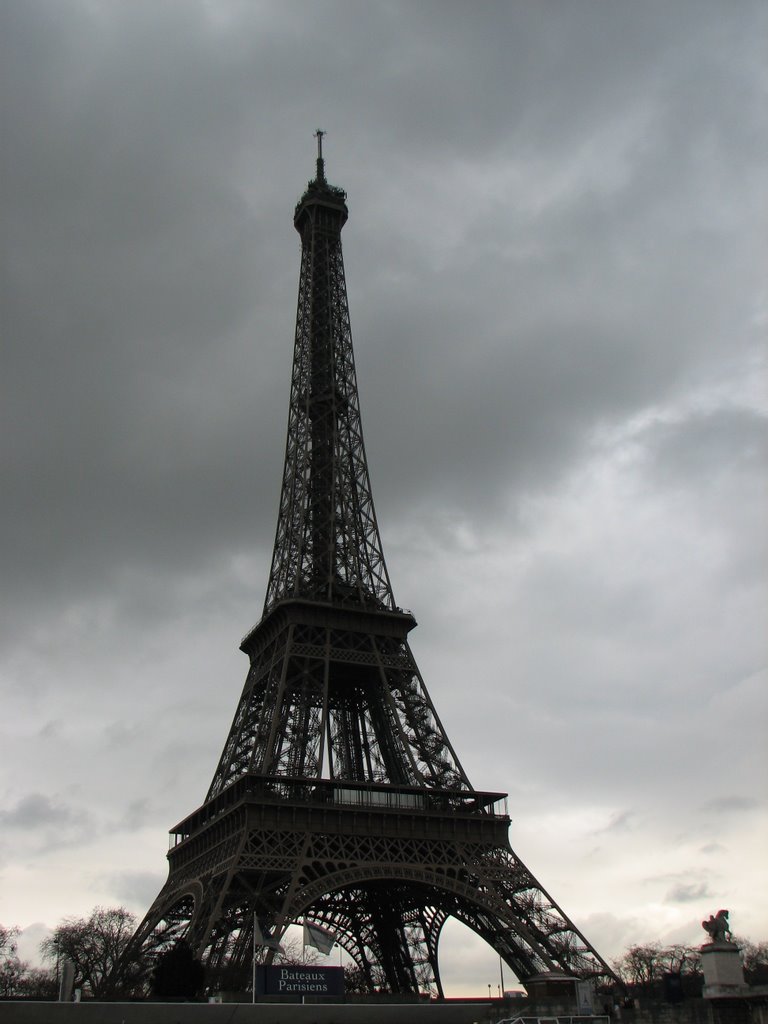
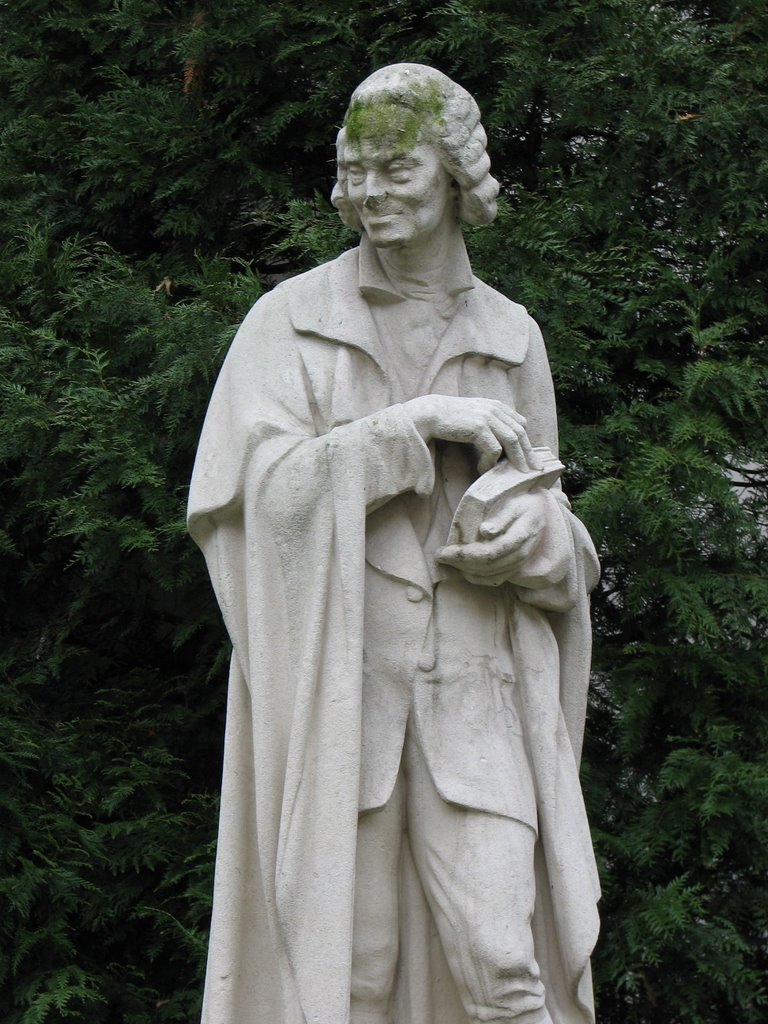
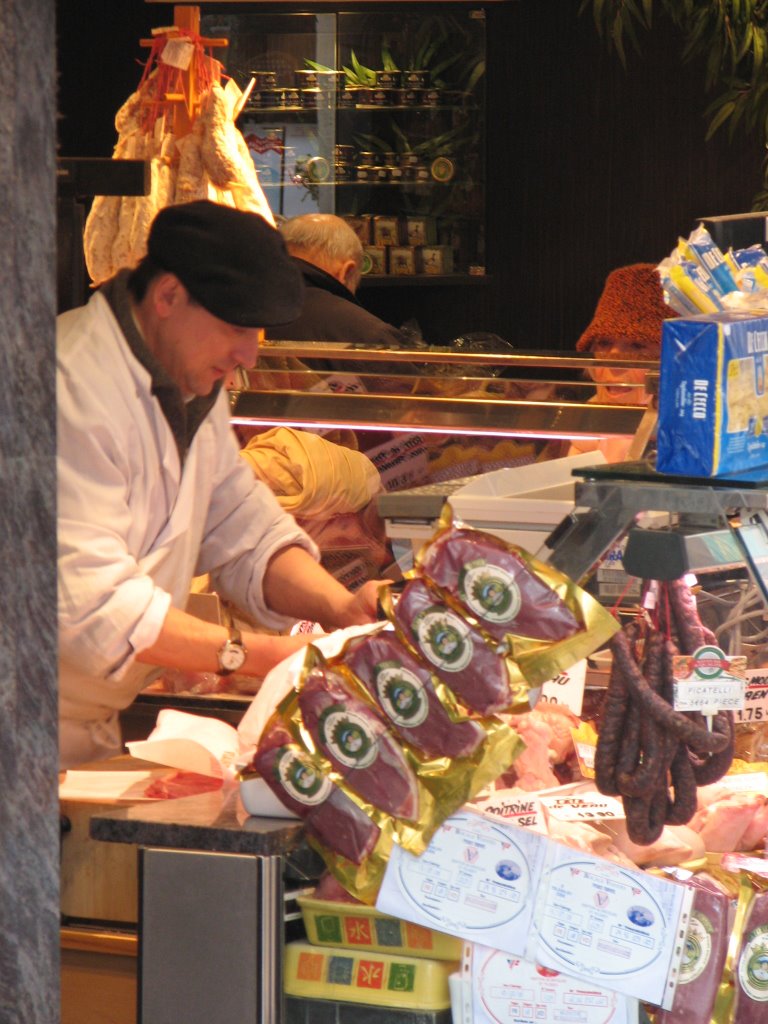
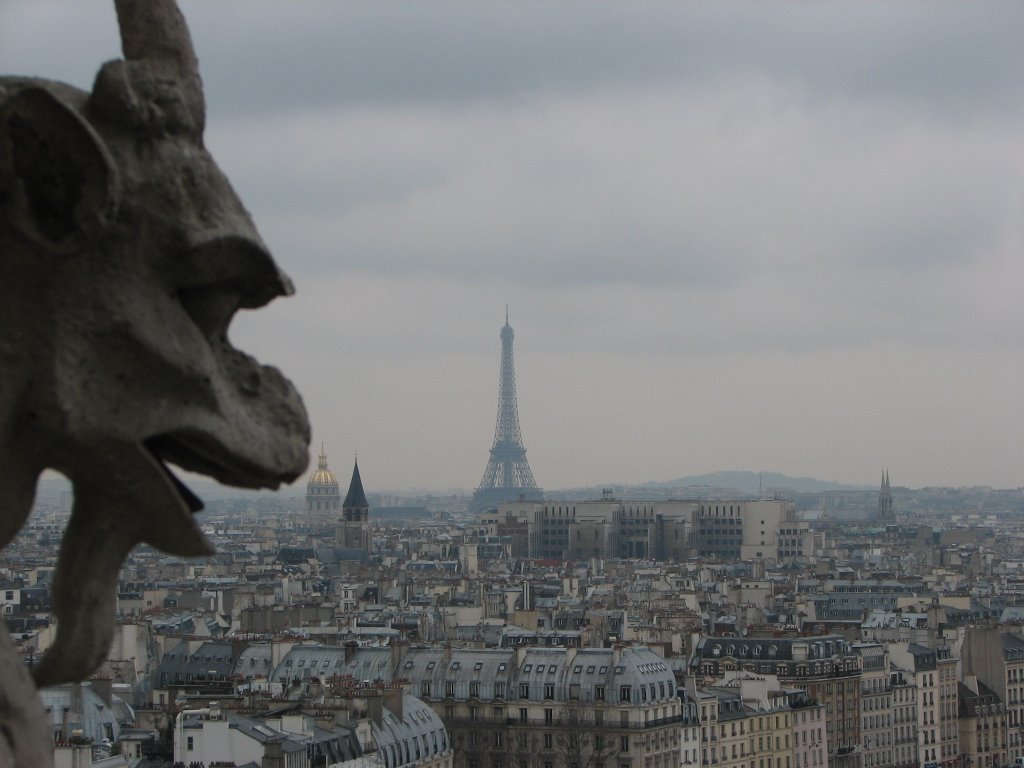
(The pictures are of Paris. I went with my dad in March.)

Sunday, May 14, 2006

Update, Long Overdue

Just recently I escaped a two-week long pedagogic torture session, affectionately know to me and my peers as “AP week.” Basically, I’ve been studying a lot and stressing out even more. As such, I’ve let this site descend into a period that can only accurately be described with one word: stagflation.

Yes, of course, that’s not the only word I could use, but it’s certainly the most ridiculous, and therefore most appropriate. Luckily for you (and no less for me) APs are over and I can begin to pick up the pieces. I’m currently working on a number of projects that require investigation into a wide spectrum of American culture and politics: unequal education opportunities, immigration, evolutionary projections on society, modern racial tensions, and the spirit of terrorism, to name a few. This research will no doubt necessitate updates, so do check on occasion.

I have a sneaking suspicion that this site is becoming increasingly irrelevant. So, in an effort to win the readership of all those metropolitan youngsters and adults out there, I’ve decided to offer a simple media rating system. As you might suspect, my opinions on movies or, for that matter, anything cultural, are uninformed and essentially valueless. In life, it’s important to separate facts and moods. The former is eternal and unchanging; the latter is vain and temporary. I’ve made no attempt to separate the two in this rating system.

Monday, April 10, 2006

Feeding the Monster: Sports and Violence


Three college students from Duke University have been accused of raping an exotic dancer at a wild Frat party. They held her down, beat her, choked her, then raped and sodomized her (innocent until proven guilty, or whatever). After the party, one of the students emailed his buddies. He promised that next bash, they’d kill the stripper. Then they’d skin her. The students were white, arrogant, and wealthy. The young girl was black. They told her, "Thank your grandpa for my cotton shirt,” as she gave them a lap dance.

As tempting as it might be, this isn’t a story of bubbling-up century-old racism. This isn’t a story of good-ol’ southern boys, echoes of their Plantation past. No. These young men are Northeastern, born and bred. They’re Abercrombie poster children of a not-so-bygone era, white SUVs, wild Frat parties, and Lacrosse bailiwicks withstanding.

More accurately, this is a story of masculinity unchecked by virtue. This is a story of entitlement and socially dignified violence, of sport ethics gone wild. These men are athletes: taught to be warriors, taught to win with aggression and taught to observe not a code of conduct universally extended, but of “battlefield honor” -- to take no prisoners, to be unified in victory and solitary in defeat. The team’s one black member and only Durham native will not describe the events in question. The mores precipitated in a group of athletes are not based on rationality, but on brute strength and high testosterone levels. Authority, quite tersely, is measured in bicep size. The group, trained to kill, withers towards barbarism if not also taught to respect and to honor. The Duke Lacrosse team had free reign over the campus.

Not all men are reckless slobs. However, (dare I suggest) tropisms towards aggression and masculine vindication are not relegated to the sports’ fields alone – but are existent in society at large. The eternal wisdom of “don’t ask, don’t tell” translates to these athletes as “win on the lacrosse field at any price,” and to our soldiers as “win on the battlefield at any price,” and to our corporations as “turn a profit at any price.” Win and fuck all collateral damage in the process.

We see a tacit acceptance of reckless and domineering masculinity on our sports' fields, because we have an acceptance of reckless and domineering masculinity all throughout society. These are the white, rich, entitled children of today that are the white, rich, and entitled Enron executives of tomorrow.

We must not sacrifice prudence on the cross of passion and aggression and victory and masculinity: “boys will be boys” should not erect a framework that legitimizes “boys will be brutes” and “men will be monsters.” As a society, we must not purchase an identity at the cost of civility. Justice must be served within the context of the problem, teaming and pervasive as it is.

Have we sold our collective soul to sports?