Showing posts with label School. Show all posts

Friday, July 13, 2007

Gap Year

Dear Mr. Fitzsimmons,

I am Max Novendstern, a recently admitted student to the Class of 2011. I wish to take a year off before entering college, and I am writing this letter to request that my admittance to Harvard College be deferred to the fall of 2008.

During my time, I plan to immerse myself in Latin America – its culture, language, history and scholarship. I have made arrangements to stay with a family friend in Trujillo, Peru, and from there, to travel throughout the continent: the Choquequirao ruins in Peru, the pampas of Argentina, el desierto florido of Chile. After travel, for the remainder of the year, I intend to find a job opportunity, volunteering my time somewhere in the region. Throughout the trip, I hope to read and write, with luck completing a year-long writing project of my own design.

In part, the reasons for the year off are academic. I will achieve greater proficiency in the Spanish language, learn about Latin American history and literature, and gain, before entering college, a greater understanding of a culture very different from my own. By discovering the foreign and uncomfortable, perhaps my understanding of the commonplace and unremarkable will click into greater focus. But the reasons are also spiritual. Sometimes I feel that I’m so busy searching on the road for the next better thing – the fruits of high school will be picked at college, then graduate school, then career – that I do not notice a bit of scenery that is whirling by me. During my year off I hope to spend some well-deserved time off the road that beats forever forward, and to simply enjoy, at least for a short time, the smiles of the people that I meet.

Bill Gates said to Harvard’s graduating class that there is almost no limit to what the world has a right to expect from them. After a year of “exploring, living, studying, traveling,” all suggested as revelatory in your wonderful article Time Out or Burn Out, I hope to gain a greater sensitivity to the pains and hopes of others, but also to the talents and opportunities that I have been gifted. I believe that I will enter college motivated to my mission by an enhanced perspective on the worlds around me and within.

Sincerely,

Max Novendstern

Note: I'm hoping to utilize this web space a lot during my travels, geographic and otherwise, so expect some layout change in the next couple of weeks, and then, eventually, photographs, maps, reading excerpts, journal entries, and essays.

Sunday, June 17, 2007

A Graduation Speech That Won't be Read

This speech is a simple reminder to focus, for the final fleeting moments in our grasp, on the connections that we have made, rather than on a future that recedes always further from our grasp. For those who have kept up with this site, it is clear that this speech – its phraseology, its ideas – is not new, but rather it is a reformulation, and I think for this reason its value as a graduation speech is greater not lesser. I was not picked to speak at graduation, so I'm posting the text here. (The speech that was chosen is certainly much funnier than this one, so I guess that's nice.)

□ □ □

We have spent tonight, with good reason and great deservedness all around, contemplating the past that has brought us to this stage, and the future that awaits us when we walk off of it. This stage is a literal barrier between the place we came from and the place where we are going: everything will be different when we leave. So, today, with good reason and great deservedness all around, we should embrace the nostalgia of the past and what it has given us and the excitement of the future and what it has to offer us.

However, I am not going to talk about either, the past or the future: I'm quite certain there are others who can talk about school better than I can, and all I can do as a student is guess about what will come next. Instead, in the no-man’s-land between these two places, the past and the future, yesterday and tomorrow, is the present. And if only for a few minutes of your time, "the present" is the setting of a short, fictional story I would like to tell. Nothing big, just a story.

The story begins very dramatically. The tragic hero of our tale lives in a quaint house off Todd Road. (I live on Toad Road, but this is not about me, it, at least a little bit, perhaps, is about everyone.) One day, maybe on the Today Show or the Journal News, he sees a map of the Katonah-Lewisboro school district. With pride, he quickly locates his house. No sooner can he point to the dot of his house, then a feeling of horror pulses through his veins. For all his life, he had known his address to read Todd Road, Katonah NY -- to his friends, his family and to the U.S. Postal Service, he is a member of Katonah. But, his house, he sees, with anguish burning in his eyes, is geographically at the heart of God's Country: his house is in Lewisboro, NY. You heard correctly: his address is Katonah, but he lives in Lewisboro. Obviously, these are the trappings of an existential crisis. He is suspended between one town and another. He is suspended between one culture and another. He is literally the dash on the Katonah-Lewisboro School District's letterhead. He realizes that he has no identity. He realizes that he has no home to call his own. Caught between Lewisboro and Katonah, welcome in neither, he is the “Man without a Hamlet.”

So the Man without a Hamlet wanders on the roads searching: He travels from the hills of Waccabuc to the waters of Cross River to the dark, frightful depths of Vista; he asks for answers from the academic, from the athlete, from the adolescent; with his head in his textbook, he travels towards the corner of Naviance; he runs towards the endzone, under the lights of the turf; he searches for the next quick thrill, at Cameron’s Deli, in the darkness between dusk and dawn.

The hero of our story travels different roads, the roads that many on this stage have traveled too, searching for that place where he can park his car, along the cobblestone, greeted by the smiles of forever. The Man without a Hamlet searches for a place to call his home; he searches for what we learned in John Jay High School is called the American Dream. The roads that he travels – that we on the stage have travel to get here – are different, of course (in the textbook, on the turf, at Cameron's Deli) but all roads towards anything are, in a sense, very much the same. They wind far onto the horizon, so that Man without a Hamlet can only see what is directly in front of his eyes. The divider lines flash rhythmically in front of him, hypnotizing him. Beating forwards with the wind whipping on his face, the line hypnotizing him, the horizon obscured and winding far into the distance, the Man without a Hamlet does not notice a bit of the scenery he is passing. He cannot enjoy the beautiful stone walls or the quotes during his morning announcements or the people around him, because he is too busy searching for something better on the road that whispers a promise of happily ever after.

One day, though, his car breaks down and he steps off the road. He does not have anywhere to go, without his car, so he decides to lie on the grass. With the sun beating on his back, he notices for the first time the people around him, and their smiles are the best part of his day. No longer traveling down the road, he feels that time is standing still, the earth is no longer rotating and the present, that Now, is everywhere. The Man without a Hamlet finds a home the moment he stops searching for it.

Perhaps at some points, we all are, in this community of vast opportunity and privilege, men and women without Hamlets. Perhaps, at some points, we all are so busy searching on the road late at night for something better, that we do not notice the scenery as it whirls by us.

I believe in ambition and idealism – I believe that this spirit, the wisdom of youth, is no less important than the wisdom of old age, just because it comes first and, sometimes, is lost like a receding hairline. That wisdom is a burning compulsion in a great many of us: we have hopes and dreams and fears; we will change to world, I am quite certain of it. However, this wisdom, I have come to believe, is only so important. Perhaps, in the final moments on this stage, before we walk off and can never really return, in the final moments we have with the school that has given us its firm hand, the town that has given us its woods and streams, and the people who have given us their hearts – perhaps for at least a few moments, we ought to stop looking to a future that beats on, forever receding in front of our eyes, and look to our home, around the stage and in the audience, in the present, and be thankful for the smiles that we see.

Wednesday, May 23, 2007

Two Proposals for John Jay High School

Managing Noise in the Library

Proposal:

To establish the back of the library – from the doors of the flat lab to the computer of the checkout desk – as a “communal work” area, where students are permitted with greater leniency to carry on quiet conversation with their tablemates.

Rationale:

Homicide, pestilence, insanity and precious stones – and a great many others things that catch human desire and passion – have all at one point or another been viewed through a cloudy lens of irrationally and mythology. Fortunately, the lights of human reason have dispelled these clouds. The first library was opened in Alexandria more than two thousand years ago, and since then, the idea of the library has occupied a place in the wildest dreams and fears of western culture. For this reason, traditions are fought for irrationally. Among these traditions, is the wide-held belief that a library – by nature of the books on its wall – must be entirely silent. This silence, however, often hurts, not helps, the positive role the library facilities play.

The John Jay High School library is regarded by many as one of the best public high school libraries in the region. Many students – the vast majority of students – who use this library want to enjoy its facilities in ways other than just silent study: working together on projects, discuss homework assignments, talk about extracurricular activities while they review their study notes. However, teachers, in varying degrees, believe that silence or near silence must be enforced in the library.

The conflict – and the tension and problems and power struggle that arise – between those who wish to work communally and those who wish for silence could be resolved if the back of the library were open to quiet discussion.


First Time Mistakes


Proposal:

To establish a discretionary “First Time Clause” whereby first-time offenders will not be removed from and/or disqualified for admittance into the National Honor Society and/or the Peer Group Leadership Program. Such first-time offenders will be put on good-behavior probation, as outlined by the administration.

First-time offender is a student without record of past equivalent infractions and without record of infractions that warranted in-school suspension or higher punishment.

Discretionary is the administration’s right to waive the “First Time Clause” if the infraction is deemed weighty enough to pose a specific threat to the wellbeing of the High School campus, such as drug possession on campus or violence on campus. Such discretionary decisions can be appealed by the student to the superintendent.

Good-behavior Probation is a period during which a student can be removed from Peer Group Leadership and/or the National Honor Society for lesser offenses and can be required to check up with social workers, administrators, guidance counselors, as designated by the administration.


Rationale:

One of the primary purposes of school is to aid students along the pathway of intellectual and social maturation. Integral to this process of growth is the prospect of punishment and reward: students must learn that actions have consequences, that grades cannot be earned without diligence and positions of leadership cannot be held without sacrifice. However, in a school, dicipline is only a means to the end, because the purpose of school is to teach, not to punish. Zero tolerance justice, the official policy of Peer Group and National Honor Society, oversteps John Jay High School's goal of aiding students as they develop to become decent members of society; it shifts the education process to the discipline process and damages futures rather than guides them.

Adolescents are not children, but they are not adults either. In opportunity, we have an adult-world expanse; but in experience and perspective, we have a child-world naiveté. And in this no-man's-land between opportunity and insight, mistakes are made. A hallmark of adolescence is error, and school functions to elucidate and correct this error.

Because adolescents are not adults, and because the vocation of the student is experimentation, high school students cannot be held to standard of absolute perfection. National Honor Society and Peer Group Leadership require students to live as role models in the school and community. However, building character is a process, not a singular triumph; likewise, tarnishing character, like tarnishing metal, is not a singular act. Students ought to be judged as leaders on how they grow from past follies, because growth, in the schoolyard, is triumph.

Providing students with second chances, and puting them through a reform probation period, John Jay High School will better realize its goals of educating rather than punishing. By allowing for error and consideration, reform will occur; conversely, by removing students from important organizations, the will to reform is struck dead, and the growth that constitutes primary education stops also.

Sunday, April 01, 2007

Bolivia's "Road of Death"

Late at night, the teenager loves the road more than he loves himself. The dark asphalt seems to whisper a promise in his ears that there is something better, a little farther down the line. And that if he could get there, he would not have to drive anymore. And it is nice, late at night, to believe that this is true. I guess he likes to believe that he is actually going somewhere in his car, that he will eventually turn off the turnpike, park in the lot and put his cellphone away. Flowers, he imagines, will line the cobblestone walkway. Cigars will be had by all, and he’ll knock on the door, and be greeted by the insouciant smile of forever. When the road ends, he just will not have anywhere to travel anymore.

It’s so dark, though, on the road late at night, and the winding of the pavement and the tall trees that obscure the vista, that he cannot see anything but the divider lines that seem to flick on forever. Sometimes, he is sure that it is better that way, because, if he trains his eyes to watch the lines, he becomes hypnotized. If he is hypnotized by the whisper in his ear, which is like a lullaby that rocks him to sleep, and the forever flickering of the line in the road, it does not matter that he is never going to stop traveling late at night. So the headlights beat against the darkness, pointing forward forever. They point in the direction of expectation, and that hope for the flowers and the cobblestone and the cigars waiting just a little farther down the line, I am told, is the American dream.

My life is about expectation. I expect college to hold something better than High School, and a good job, with a paycheck too, to be better that college, and a family better than a paycheck. When, though, do I reach the cobblestone walkway, and no longer have to expect a future that is better than the present? Maybe I should feel empty that I lived for an acceptance letter. Now it has come, with brilliant luck and success -- more of both than I could have ever hoped for. But it turns out, the acceptance letter is only made of paper and ink. I suspect sometimes that I have not noticed a goddamn bit of the scenery as I travel late at night on the road, because I have just been so consumed by the sultry promise of the line that flickers forward forever.

It is a cliché to say that life should be lived for the moment – that those occasional Nows, when the earth stops moving, and the entirety of everything is felt in another person’s skin or the ecstasy of a thought, is all we really have. Well, sometimes clichés click into focus, and I begin, like it was the first time ever, to understand what I have said out of habit a hundred times before.

Saturday, March 10, 2007

Start the Dialogue

The story of the three girls who said the word vagina has spiraled beyond the sane minds that originally drafted it. Beginning with the absurdity of a decision and propelled by the booming madness of a mob, the episode has taught me, among other things, the power of spoken words, and the power of the individual to precipitate a storm. I do not believe that the administration was villainous. However, I do now believe that it is only with negative press that justice will be reconsidered.

The pertinent question is, To what extent does John Jay High School retain the obligation to shield its community members from uncomfortable subject matter? According to Hazelwood School District et al. v. Kuhlmeier, "a school must be able to take into account the emotional maturity of the intended audience in determining whether to disseminate student speech on potentially sensitive topics." What does this mean?

Importantly, it is not important (necessarily) that the word is “vagina,” and that the word ought not to be associated with badness and impurity or that believing that it should is degrading and the social expression of thousands of years of female subjugation. I happen to believe these things are true; However, parents in our community can believe otherwise. Indeed, these parents, so long as their children are legally theirs, have the right to inculcate ignorance, and it is illiberal to say otherwise.

The real issue is that as a school, John Jay has the educational imperative for diversity. Importantly, adamantly, is this: just because someone feels uncomfortable by the sexual politics of the Monologue, it does not mean that he is entitled to censor it. Because that would mean the end of education. How would I know what I believe, if I were not exposed to that which I did not believe? How would I know the bounds of my own civility, if I were never made to feel uncomfortable.

As a liberal society, we place the right over the good. Meaning, we establish a sense of justice, what is right, without mandating how that right can be exercised: We say speech should be free, but we do not say what that speech should entail; We say thoughts should be unfettered, but we do not say what those thoughts should entail. Likewise, one of the foundations of our society is the principle that institutions cannot coerce individuals into opinions. In this case, our school cannot force a breed of sexual politics onto a helpless community and – and this, I believe, is of tremendous importance – the community cannot in turn corrupt the educational environ of the night by forcing its breed of sexual politics onto the school.

The nature of words, of an Open Mic Night with minds sentient and free, facilitates this medium, where neither the school nor the community has ultimate domain. Words are non-coercive. Just because someone hears something that they do not like, (say) a monologue about the vagina, does not mean they have been coerced. It does not mean that the school is imposing its sense of good onto the community. However, by censoring that word, the community is imposing, in a very explicitly and coercive way, its sense of good onto the school system, and onto me and those three girls and onto everyone in the room.

And that is the line where censorship is violated. At an open Mic Night, the individuals in the room have tacitly renounced their right as minors to be shielded from the entirely comfortable. They have affirmed that they can discern ideas from each other, from that which they do support from that which they do not, and, resoundingly, that they will take up the challenge of a liberal education: to determine for oneself what one believes.

Saturday, March 03, 2007

Censorship at John Jay's "Open Mic Night."

To the students and teachers of John Jay High School:

On Friday, March 2nd, at an "open mic night" sponsored by Reflections, our school's literary magazine, three junior girls were suspended when they ignored the advice of the administration and decided to use the word "vagina" in their reading anyway. They used the word only once. The word, for those you who are unaware, refers to a body part that, I am quite certain, at least half of those in the room had that night, and all in the room, at least in passing, had heard of before.

A democratic society depends on an electorate educated in more than integral calculus. John Jay High School has an obligation, paramount among others, to impress upon its students, the future leaders of our nation, the tenants of a healthy, free society: fairness in deliberation, equality, justice, respect for others and the right to dissent.

By that standard, I believe John Jay High School has failed.

As a school system, we must stand by the clear, unequivocal declaration that sex is neither wicked nor sinful. The suppression of sexual knowledge is not only an intellectually repressive practice, but also the cause of a great deal of human unhappiness. Knowledge based on deception and filtration is not knowledge at all. And I cannot support a decision by the school's administration to sponsor ignorance – especially the breed of ignorance that debases a topic, such as sex, that is so vitally important.

From what I gathered, the intent of the students' reading – an excerpt from the award-winning play "The Vagina Monologues," a play I saw just one week ago – was to celebrate femininity, what for so long has been seen as frail and inferior, or lascivious and sinful. The students uttered the word not as an admission but as a declaration: no longer should a word so natural and important be shrouded in a mist of ignorance and irrationality.

It is the height of irony that by censoring this word, and by punishing those who said it, the administration has compounded the mist of ignorance and irrationality that the word set out to dispel in the first place.

As I listened to the various voices and words of my peers and teachers at the "open mic night," I realized that my purpose in being there, all of our purposes, was to celebrate the individual's voice. Perhaps it is true, as I very much believe it is, that Mr. Cass and Ms. Kor, by making the decision to suspend the girls for their mentioning of an anatomical structure, were attending not to their own personal beliefs, but to those of a vocal minority in the community. However, by capitulating to the simplemindedness and bigotry of a few, and consenting to suppress the free exchange of literary and important ideas, the administration was undermining the most basic principles of the "open mic" that night and of the writers who were willing to share their words.

Even if you are not sympathetic to the girls' use of the word "vagina," or even the purposes of their reading, I hope and trust that you are sympathetic to the premise that human prosperity depends on the expression of a diverse array of ideas, and that in an educational institution we are entitled to hear these ideas.

What is needed now is not less speech, but more. These girls took a great risk in defending their convictions. I urge you to contact the administration saying that you do not support its decision to punish girls who had the integrity to stand up for their beliefs – that in a school system, information ought to be open and diverse, and ignorance combated.

Saturday, December 09, 2006

Cameron's Culture


I wrote a short story about suburban adolescence.
He is not a kid, but he is not a grown-up either. And in this no-man’s-land between the innocence of childhood and the dreariness of adulthood, right off Route 35, is Cameron’s Deli, open 24 hours a day, seven days a week.
Read it and tell me what you think.

Added:

The Lewisboro Ledger's take on the story.

"Where some of the pieces could have been racy, most of the presenters censored themselves. Max Novendstern’s story Cameron’s Culture was punctuated by occasional uses of the word “obscenity” to fill in for less acceptable words.

Many of the works were autobiographical or personal, such as Molly Chambers’ essay, titled My Favorite Place in the World. Others, like Max’s story, were more fanciful" [Emphasis added].

Tuesday, September 26, 2006

Zero Tolerance and Prison Ethics

New York state generally believes that no rehabilitation measures can cure the latent danger of murders, rapists or other menaces who diminish the wellbeing of society. If the warden, twirling his nightstick, sees drugs in the prison yard or knives in the cafeteria or hears threats shouted through the cell doors, he punishes the prisoners quickly and without remorse, without discretion and without leeway. After all, inmates detained in high security prisons are dangerous folk, and nothing can fix that.

This Draconian discipline philosophy makes a great deal of sense in a system designed to punish and ostracize lowlife prisoners. But in a suburban school in place to equip teenage boys and girls (who aren't dangerous folk) with the skills needed to succeed in the real world beyond Cameron's Deli, the prison ethic that knives are for killing and drugs are for destroying is wayward, dangerous and the cause of a great deal of human unhappiness.

In the age of zero tolerance, the buzz-word for school administrators, discipline hearings conduct themselves as trials in carnival courtrooms of the absurd. A picture with a beer bottle means forced abdication from peer group, National Honors Society, suspension from sports teams, poetry clubs and Campus Congress. No questions asked. A pocket knife equates to five day suspension regardless of intent or motivation or circumstance. Signing a yellow pass without a monitor so one can go home on the late bus – a requirement bafflingly illogical – means forgery and theft and destruction of school property and a five day suspension reported on the college application.

Teenagers do foolish things and make nonsensical decisions; That's the hallmark of being an adolescent. We're certainly not children, but we're not yet adults. Sure, mistakes are made, but even by the most decent and forthright students. Gratuitous violence is a rarity, so why assume that a pocket knife is a weapon? Fraternizing and co-mingling with others that drink beer is a requisite, so why treat such actions and wicked and evil and punishable in an extreme degree? Because there's a slip-up doesn't mean we're armed and dangerous, prepared to destroy the world's gentle. It means we're teenagers. It's gleefully understood by administrators of school justice that no-mitigation five day suspensions are permanent fixtures on a student's college application. If we're decent and well-meaning students and not despicable fugitives, why do our punishments damage our futures rather than guide them? Why do they destroy rather than improve?

It's a truism that any philosophy taken to the extreme is bad. But the impulses behind zero tolerance (the name itself belying its sanity) are a reflection of the broader impulses behind Americanism. There is no statistical evidence whatsoever that zero tolerance works to decrease school violence or drug use; Instead, it's a political and symbolic policy that reflects in a nation whose flag colors don't run our collective fetish for “personal responsibility.” We pull ourselves up from our bootstraps, we wage war on poverty, drugs and terror and we need to take ownership of our actions. We prosecute the “bad apples” at Abu Ghraib, but don't investigate the insidious undercurrents that the apples grew from. To admit that perhaps teenagers drink because they're stifled and bored or cheat on tests because they're beaten by the high expectations of John Jay hyper-competitiveness, to suggest that certain banalities are symptomatic of broader pathologies of adolescence would be permissive, and permissiveness is the sign of an ideology which is in serious disfavor. The advocates of zero tolerance scoff at nuance as yellow-bellied and discretion as weakness.

Zero tolerance leaves a profound impress on the minds of the decent future leaders of our world that they are not teenagers who might make a few mistakes, but are inmates in a dreary bureaucracy where procedure takes precedence over common sense, where authority is the enemy, justice is irrelevant and the distinction between a school system and prison system is merely rhetorical decoration.

Saturday, July 29, 2006

Thinking about the Dog Days

What a wonderful summer indeed! I'm quite content. No, I didn'’t intend to be content this summer and I certainly didn'’t expect to be, but the peculiar admixture of sufficient sleep and stress-free intellectual stimulation has done wonders. This brings up an important epistemological question: Why am I learning more on both the human and academic level during summertime than during the school year?

One answer has to do with the emphasis of the public school system. Any education institution that assumes near perfection from nearly everyone is an institution designed for stuffy mediocrity and base unoriginality, plain and simple. Each and every day I'm told in school, "This is very easy. You ought to get everything correct."” So, like the obedient student I am, I try to get everything correct. All of my peers too try to get everything correct and we collectively choreograph a cut-throat dog-fight, where I distinguishing myself based on the point in grade spectrum from 90 to a 100 that I land. I can'’t help but think that it'’s fastidiousness and precision that'’s emphasized in system like this, and that higher pleasures such as creativity, abstractness, passion, and logical advancement are merely second thoughts. Intellect is collateral damage in the college process that demands hyper-perfection.

If the summer is when the real learning takes place, then what have I learned? Here are but a few things, and I make no apologies for my delightful obscurity. (The number/bullet point is the paragraph's lazy drunkard cousin.)

  1. The environment is worth hiking for. See: the front page of the Ledger, Tree Hugging Chronicles
  2. If you feel insecure or overly exposed, just strangle the bothersome emotions with words. Basically, over-articulate unadulterated feelings and those feelings become torpid under the linguistic weight. Then you can then just brush them aside. See: Sunny from the Catcher in the Rye.
  3. When you commute three hours to work each day, you lose a little bit of your money and a little bit of your soul. See: Psychiatrics at the New York Weill Cornell Center. Am I worker or a patient?
  4. Drugs are a decidedly unattractive option. See: Requiem.
  5. Bad things happen when you revel in your anonymity. See: the "Prick Debate." 1
  6. You mustn't start a clause with "Due to." -- it means "caused by" not "because of." Also, "different than" should be "different from."” See: Cliffs Guide to English Grammar.
  7. Don't ever enter a car if you don't know where you're going. See: Cameron's Culture, the teeming underbelly of John Jay social life, the nihilism that that thrives in the darkness between dusk and dawn and feasts on quick thrills and empty promises.
  8. Arrogance can actually be palpable. See: www.TheLiberalConviction.com.


1. Update: though my remark about loving nom de plumes but hating the French was brilliant, I've decided -- after a request and a little book learnin' about AOL proxy servers -- to respect the American legal system and suspend my conclusions, as I believe that reasonable doubt still exists. I was soundly reminded that slandering someone anonymously is just as morally reprehensible as defaming someone illegitimately.

Saturday, June 24, 2006

The Value of Leisure

“Idle hands are the devil's tool,” I’m told by my high school teachers and classmates each and every day; because of such nonsense, free time for me often becomes little more than a source of guilt and uneasiness. Now that summer has begun, what shall I do without rubrics or multiple-choice scantrons to guide me, I ask. If I’m not systematically producing something, then I feel helpless and lost and insignificant. There’s a moral quota on busyness and occupied time, and I’m tyrannized by the guilt of not filling it.

For the vast majority of human existence, labor was performed out of necessity. A family produced for its own survival: if there was a drought, then a great many farmers starved; if there was a frightful winter, then a great many families froze. This day-by-day sustenance living continued from the birth of civilizations all the way until the Industrial Revolution. Where leisure existed – the class of it, for example, that gave rise to the majestic Athenian culture – it was afforded by the servitude of the slave or the blood and sweat of the peasant. This system, however, is no longer necessary. Leisure is a value that can be enjoyed by all, because modern technology has allowed for great abundance. Modern technology has the potential for bestowing great prosperity and happiness; it can allow for human liberation from the cogs of continuous, exhausting labor.

America’s value system of rugged individualism will have none of that laziness, however. The pre-industrialization daily routine, where work was necessary for survival and idleness quite simply led to death, left a profound impress on the human ethos system. The moral impulse in today’s high-paced society is that leisure is wicked and that work is noble. These values are anachronistic at best and the source of a great deal of unhappiness at worst. The Slave Ethic that work for a profit is morally righteous exists in a society where it is no longer needed. Our industry could cut the employment of all people to four hours a day, and distribute those jobs evenly. It would then produce as much product but employ far more people and afford far more leisure. Instead, we allow some to be drastically over-worked and others to be unemployed and starving. This is patent foolishness, borne out of an antiquated moral system.

Intelligent use of leisure is tremendously important. Work kills our capacity for intellectualism; it makes us passive and beaten-down. As a culture we have nothing more than mindless sitcoms and air-brushed pornography to succor our psyche in a state of exhaustion after strenuous labor; as a culture we crave an escape from reality – liquor and television and vacation – rather than a fundamental enjoyment of it. This passivity and escapism could be cured leisure.

Thus, during my free hours this summer, as the days slowly creep by, with lemonade and birds chirping and sunny skies, I hope to invest my energies in the higher pleasures: maybe I’ll read a little, maybe I’ll write a little, maybe I’ll go to some museums. A good test of a man’s moral character is how he uses his free moments. I hope to remain productive – in a leisurely way, of course.

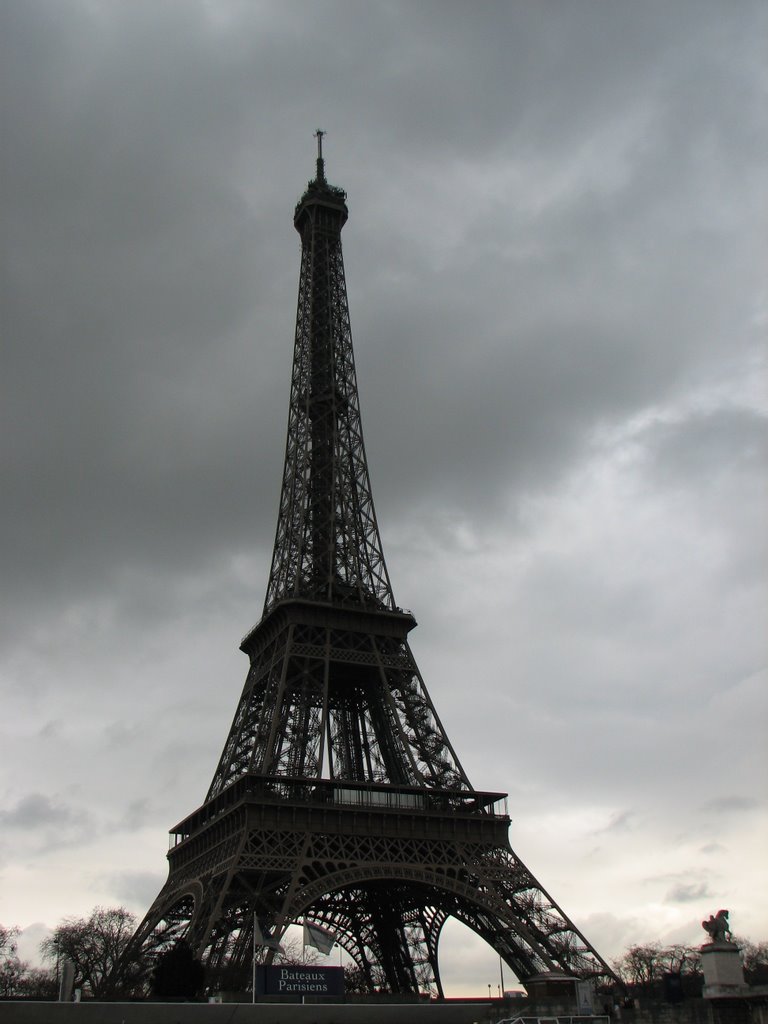
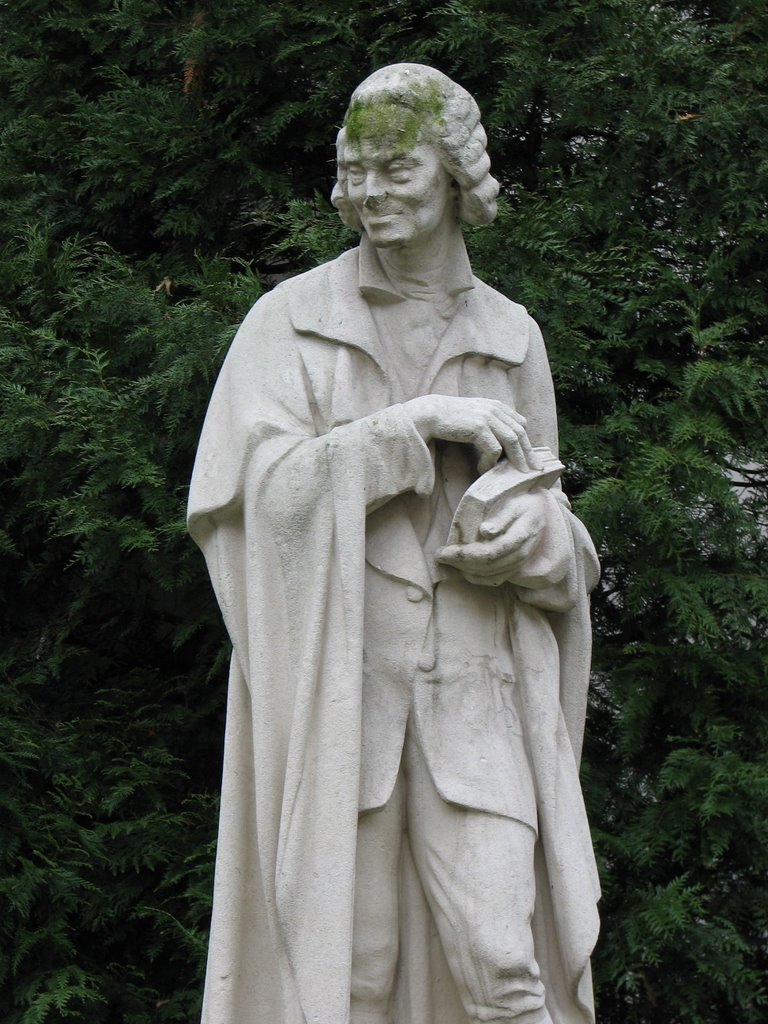
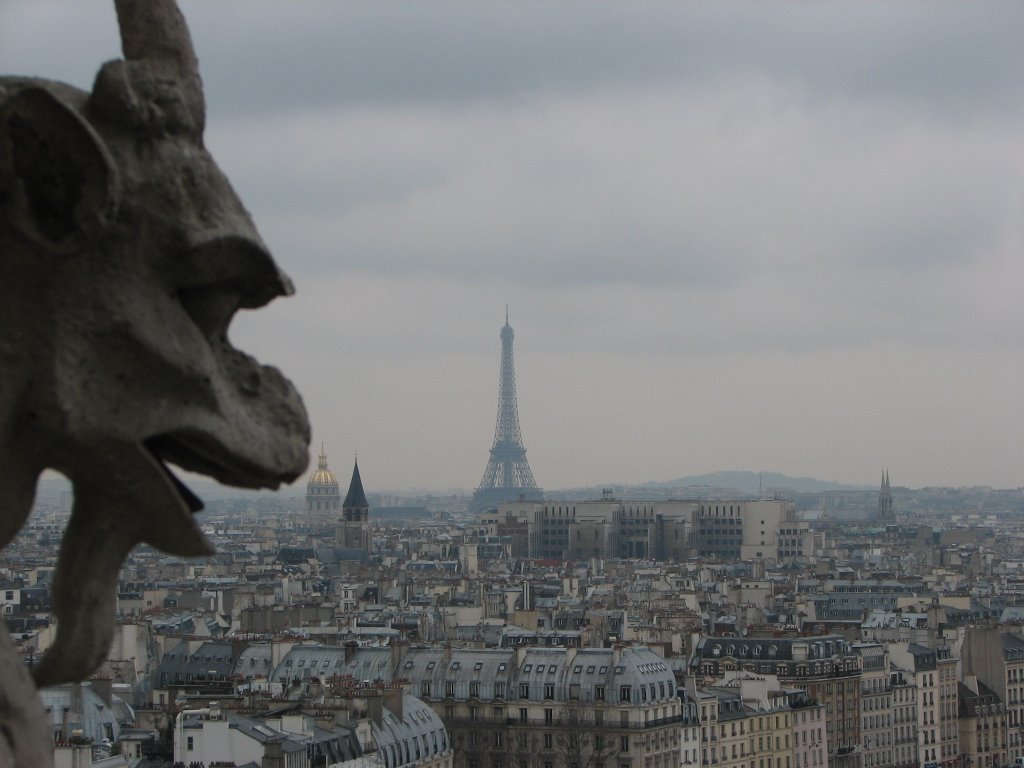
(The pictures are of Paris. I went with my dad in March.)

Monday, June 12, 2006

On Behalf of Ms. Potter: In Defense of Bias

On the first day of school, as newly christened juniors shuffled into their chairs, my U.S. history teacher remarked, unapologetically: I am liberal. I am opinionated. I have prejudices. This course is going to reflect my biases, and you ought to get used to it. So, as the school year comes to an end, I reflect on Ms. Potter's declaration, on academic freedom, on personal truth and on public dissent -- ideas clearly congruent with the general direction of this site. Dissent, after all, is fundamental to democracy, and all that jazz. What an appropriate end to the school year!

I am very pleased with how this paper turned out. This site, I suppose, does a nice job of chronicling my development as a writer and thinker. If you have ten minutes, consider reading In Defense of Bias:

Archibald MacLeish, American poet and minister of propaganda during World War II, said in 1954, that, "The dissenter is every human being at those moments of his life when he resigns momentarily from the herd and thinks for himself."[1] MacLeish said these words knowing very well the repressive power of the social herd. He said these words knowing very well that more than the size of America’s guns or the tenacity of its Army, the bravery of its dissenters, the men and women willing to cast aside the warm comforts of intellectual conformity, is the most important defense against encroachments on beloved freedoms and ways of life.

Truth, the goal of the dissenter, is a peculiar concept. It is stubborn and uncompromising, yet elusive and unsettled. Bias too is truculent in its certitude, but forever unresolved. The distinction between the two – truth and bias – is no one’s job to determine. That’s the beauty of a marketplace of ideas, of pluralism of thought. Recent legislation, including the “Academic Bill of Rights” pushed by conservative intellectual David Horowitz, intends to broaden the ideal of “academic freedom” to mandate “intellectual diversity” on university campuses. The aim, simply, is to eradicate bias. However, in the process of eradicating bias, the locus of regulatory control is shifted to the student body. The uncomfortable student gains the prerogative to destroy truth labeled as bias, and the dream of higher education, the dream of answers, is subverted, only to be replaced by the dreary acceptance of political correctitude. In the quest for “intellectual diversity,” students gain new weapons to attack the dissenter who – if only momentarily – leaves the herd to think for himself.

The history of academic freedom is the history of liberal thought. It is no coincidence that the rise of academic freedom as a stated initiative paralleled the upsurge of free expression in Europe. The liberal outlook on knowledge states that all truth is questionable in various degrees, and from there, that the most important safeguard against myopia and bigotry is pluralism of thought. The protection of academic free thought thus facilitates the quest for knowledge in the liberal sense. Liberalism makes no judgment about the veracity of dissent; instead, it pits dogma against dogma, prejudice against prejudice, and truth rises to the top of the intellectual free-for-all. The function of academic freedom, broadly, is to protect this clash of ideas and values. Continue reading here.


[1] Lewis Lapham, Gag Rule (New York, New York: The Penguin Press, 2004), 1.

Tuesday, August 30, 2005

Email of the Day


"You'’re a very talented writer, and your thoughts are appreciated."

So, my first piece of fan mail, what an honor. I know what you'’re thinking: no, it isn't from my mother. But wait, there'’s more!

However, I think you should take time to think about how flawed your religious perceptions may be.

This could be interested. Here'’s a response to my post "“Religion and Philosophy"” by a friend of mine, Brittany Crowley:

Firstly, you addressed your place to question existence and a higher being. You stated, "“I'’m certainly not arrogant enough to assume that I can conceptualize the existence of God." But are you arrogant enough to assume that you can draw conclusions about the effect belief in God has on a person, when you cannot even grasp His existence? Certainly a humble scholar, like yourself, could be inclined to refuse ignorance, and accept the fact that a human mind can only capacitate so much. Faith is an especially abstract human quality, that is experienced somewhere beyond the mind. Egotistical intellectuals, who feel that they can prove everything through the known senses, often reject belief in things that are intangible, like God.

Secondly, you declared, "“I feel that organized religion emanates intolerance by preaching the ideals of universal righteousness."” Pardon the characterization, but, what a liberal statement! The theory of "tolerance"” is one that demands acceptance of others- regardless of one'’s own awareness of how right or wrong others"’ actions may be. By the end of your post, you claimed that you are "“proud to be in the United States"”, a country founded on the ideals of righteousness. Our founding fathers, in their sweat and blood, strived to build a nation that would rise up and do that which is good and right. As a proud American, you would no doubt, agree that the expression of oneÂ’s freedom of speech and freedom of religious orientation do not beget a void of acceptance for others. The goal of righteousness is surely an intrinsic one in, not only Americans, but all humankind. This goal serves as an impetus for strong, national development.

Your sentiments are a bit preemptive (and more than a bit defensive): I make no attempt at an empirical argument "“through the known senses"” against the existence of God, as you allude to in your first paragraph, so don'’t worry. In fact, I readily concede that the, "“human mind can only capacitate so much,"” and therefore God, at least in this forum, is not in question. Pantheism, monotheism, and atheism, these are manifestation of an attitude towards God constructed (presumably) by "“egotistical intellectuals"”; however, none of these arguments are addressed in my post. Rest assured.

Instead, Brittany, I discuss the effects of God as an institution, nearly all of which I believe to be entirely pernicious. You mention the idea "“tolerance"” as a defense of a Universal Code of Righteousness, a code which our Founders, you claim, fought and died for. Your argument'’s an odd one: Righteousness, by definition, is the antithesis of tolerance. In fact, tolerance is the most potent argument against Righteousness, in all respects. Righteousness, as you'’re well aware, indicates that Ethical Codes are wholly objective, and that morality is embedded within that Code, and that Code alone. Tolerance mixed with Righteousness, Brittany, would invariably be insincere: tolerance, at least real tolerance, isn'’t not killing people whom you feel are benighted, hedonistic slobs; instead, it's acknowledging that Truth can be derived in various ways, that others, even those who are different, can be correct in the eyes of God.

Righteousness, within the Institution of God, is not predicated on human happiness, instead it'’s an arbitrary set of rules, at least in my mind. Not only are these rules arbitrary (in relation to happiness) but, perhaps more pertinent to this Liberal Conviction dialectic, they are absolute in intent and objective in consequence. Your argument, seemingly, is self defeating: though our country may (or may not) have been founded on ideals like "freedom of speech"” and the "“celebration of intellect" these are not the ideals espoused by the Institutions of Religion and therefore do not fit within a concept of Universal Righteousness which I'm arguing against. Your talk of, "that which is good and right" undercuts your argument about tolerance, as you implicitly acknowledge that Goodness and Rightness are objective values within a Universal Code. Tolerance, as mentioned above, if anything, is the accepted divergence from a Universal Code of Righteousness, not part of The Code itself. Tolerance does not dethrone The Righteous from an attitude of condescension, unless Righteousness itself no longer exists.