Showing posts with label Blog. Show all posts

Monday, July 13, 2009

A Few Comments About the New Site

Welcome to the new site. I'll say: notice the larger text, the simple, black-and-white color scheme, and the data streams on the sidebar. This is what's called Progress. To understand this, you'd probably have to have been following The Conviction since my sophomore year of High School -- we've been a long time since then. The site has changed a lot, and now, once again, it's time to tighten the slack and rethink the sort of stuff that this site tries to do. So if you'll indulge me, the following post is basically some thoughts on that question of making this space matter again, and some other stuff too.

In one sense certainty, it's an academic project. My aim with this site is to develop a system for the thoughtful management of information, a system to deal with the mass of data I encounter day-to-day. The rss streams on the sidebar are a part of this. The posts, once they come, are going to be part of this as well. My idea is to somehow post "abstracted/raw data" from the articles I'm reading and from the ideas I'm playing with. I want to focus on the act of writing (of producing) as an act of editing. Writing as parsing and winnowing. Writing as a quantum of information, but also as a vector (as DFW once wrote).

That's my goal -- and, frankly, I think that few projects are more important. Information abundance is characteristic of our time, of my own life, and one of the thing that we've learned for sure is that information alone does not mean truth or knowledge. In fact, it's vividly clear that the opposite can be true. Abundance can breed its own forms of unknowledge, its own forms of exclusion and control, its own new, special forms of helplessness. We can drawn out totally. And if we're not drawing, we're defecting: defering control of our information flow upwards, or cowering into dogmas, or otherwise resigning to being hopelessly ignorant, totally abject. These are the pathologies of information abundance. They are the pathologies that result from the condition of having too much and too many, of abundance unmatched by an ability to reckon with it. I think I can go further and say that so long as we continue to deal immaturely with information, then we'll continue to be fucked in the special ways of the recent past. Look at the financial crisis and the role information asymmetry played in creating moral hazard; or look at the Iraq War.

For those of us who want to make some decently accurate choices about what to believe, whom to trust, what to do, then the process begins with making serious choices about what information we consume and how we do it. I'm not there -- not even close. But I'm trying, and this blog is small part of that.

So that's the first point: information control. But I'll admit that there's more. If you stop reading here, it's fine, because the rest of this post, I'm afraid, might start to unravel. (This I suspect is going to be a characteristic overplaying of my intellectual hand. Usually I regret it.) This project, like a lot of blogs out there, is not just about providing content for the reader, but about providing content for the writer. I'm asking my readers to participate in my own self-help.

The gist is this: if I want to grow then I've got to be willing to fail. That's my main point. If I want to write and think better, then I've got to write and think more; if I want to succeed, then I've got to go through the very unsexy process of attempting, of confronting my assumptions and bringing them to bear and then ripping them down; of writing again and again until one piece -- finally -- succeeds, after a hundred -- ultimately -- have failed.

It's paradoxical, sure, but I'd argue that there's dignity to failure. To fail is to try, and to try -- in an age that has surrogated "physical fear" (fear for one's actual life) for "social fear" (fear for one's social life) -- is to be fearless. Failure is a willingness to fuck up and embarrass oneself for the purposes of making art or doing good. And that's meaningful. In an age that has redefined fear, failure is one of the closest things we've got for proof-positive evidence of personal bravery.

Maybe there's more. Maybe it's not just that we fear for our "social lives" but also that we fear the sort of truth that failure gives us. When people say that "you learn from your mistakes" they don't say anything about exactly how you learn. It's truth that hits hard. Anyone who's ever failed -- I mean, really failed -- knows what it means to get truth like a blow to the face. It's truth that burns in your eyes; to fail is to sit on your bed in midday and look at your placid hands and to look at the shadows on the wall and to feel that moment of violence come down on you; it's to forget yourself, your ambivalent, postmodern self. And at the same time it's to remember yourself, to remember that at least you have a self, that you've lived through darkness, that you'll be here tomorrow. Maybe people are afraid of failure because they're afraid of truth, or at least that very special, very place-putting kind of truth-as-blow-to-the-head that failure gives us. A life without failure means a life where this sort of special bravery and special truth -- I think the term is "wisdom" -- would be very far off indeed.

So these are roughly my intentions. To try, to write a lot, to fail a lot, and thus to grow. I take Becket's line in Westward, Ho! as my guide here: "No matter. Try again. Fail again. Fail better." That's what I want this site to be about.

I'll say, in closing, that the process I've attempted to describe is not just a personal-self-help thing. The whole failure-based model, unillusioned as it is about the messiness of progress or the priority of empirical experience over theory, yet still committed as it is to beating forward, to progress despite the fear, to engaging in the project of being better no matter how ultimately unperfectable man is -- this is the model of an American cautiousness, of an ad hoc hopefulness, and it probably has a lot to do with what "the liberal conviction" can means to us in this day and age, in the first place. So, once again, I'll say, "welcome to the site."


N.B. I haven't figured out how I want to archive my old posts. So until then, I'll just throw up a few indicative pieces, from an earlier age...


Cameron's Culture (Dec. 2006)


Two Years Old Today (Feb. 2007)
I feel silly now, that in my trepidation, I overlooked the fact that no one ever said free speech was supposed to be clean and grammatical. It should be boisterous, unruly and unapologetic, and the Internet is just that. In one fitful stroke it empowers both brilliance and bigotry, pitting one post's flaws against another's, dogma against dogma, prejudice against prejudice, hoping that truth rises to the top of the labyrinthine pile of incoherency and inaccuracy. Sure, the Internet is not authoritative, but, in all of its blemishes, obscenities, inanity, and openness, it is the ultimate free marketplace of ideas. Blogs don't claim to be correct, only curious.

"Censorship at John Jay's Open Mic Night"
(March 2007)
From what I gathered, the intent of the students' reading – an excerpt from the award-winning play "The Vagina Monologues," a play I saw just one week ago – was to celebrate femininity, what for so long has been seen as frail and inferior, or lascivious and sinful. The students uttered the word not as an admission but as a declaration: no longer should a word so natural and important be shrouded in a mist of ignorance and irrationality.

It is the height of irony that by censoring this word, and by punishing those who said it, the administration has compounded the mist of ignorance and irrationality that the word set out to dispel in the first place.

Start the Dialogue (March 2007)
The real issue is that as a school, John Jay has the educational imperative for diversity. Importantly, adamantly, is this: just because someone feels uncomfortable by the sexual politics of the Monologue, it does not mean that he is entitled to censor it. Because that would mean the end of education. How would I know what I believe, if I were not exposed to that which I did not believe? How would I know the bounds of my own civility, if I were never made to feel uncomfortable.

Caramoor
(May 2007)
The guests told Walter that they felt as if they had traveled to another country when they visited his home. Perhaps what they really felt, is that they had traveled with Pizarro himself to Cajamarca, and that they had witnessed a massacre. Only in Caramoor, it was not the Incas who were slaughtered; it was time and distance and culture and everything that could die did die. So nothing that survived in the halls of the mansion could ever die anymore, for pretty things like paintings and old swords and reliefs could live for a very long time, without context or soul. One man's suffering and another's genius were owned by Walter Rosen and hung up among the ruins in the rooms and corridors, like a fantastic museum of cauterized splendor.

Farewell Speech to Campus Congress (June 2007)
I am saying this, quite simply, because representation is not always easy. When we act there are going to be costs. But I believe, and I believe this from my heart, that if there are costs when we take action, then the costs for inaction are far greater. To ask a question our school district asked itself this year: What harm can come of words? Perhaps words can cause harm. Perhaps that is true. But ask yourself: What is the harm of no words at all? How can we understand who we are, the bounds of our own civility and our own ignorance, if we cannot hear aloud what others think? Of all the values a society, or a school system like this, can have, the willingness for open discussion is our most important. If we cannot meet and talk freely about our own stupidity and our own potential, then we might as well be going to class to learn fairytales each day.

Graduation Speech: The Man Without a Hamlet
(June 2007)
The roads that he travels – that we on the stage have traveled to get here – are different, of course (in the textbook, on the turf, at Cameron's Deli) but all roads towards anything are, in a sense, very much the same. They wind far onto the horizon, so that the Man Without a Hamlet can only see what is directly in front of his eyes.

A Very Short Love Letter to America (Oct. 2007)
This small collection of pictures spans a time period from the beginning of the summer -- to me known as the Summer of Love -- to the end of my travels in the West. Though this period is rather short, I will remember it as endlessly long. How long is the moment that a ball tossed in the air stops and sits before it travels down again? There is a moment that the ball does not move. This is the moment of transition, of reflection; the ball is at once traveling up and traveling down; this is the moment that glances at infinity, that is outside of time, has no beginning, no end and is infinitely short. Therefore the moment is forever. For me, that is the feeling of this period in my life.

Herzog Review (Feb. 2008)
Thus, we begin with a vision of what it means to be human: freed from type. Freed from the predictable. Too diverse for ideology, too beautiful to be any one thing.

Watching Ayacucho
(April 2008)
Max! he scolded, get to the point. But what is the point? The point is knowledge and love and human suffering. That is the point. The trains that Kerouac jumped existed because of collective man and radical hopes and the slouching and trembling brotherhood I call progress. What a fool to revolt against the very society that permits your existence. Kerouacs glowing on the margins – we cannot have that, in this struggle to survive. The real kind: people are dying.

Crossing Borders
(May 2008)
Eventually they just looked at each other. She asked him what he was thinking. He said he was thinking about flowers and clouds and then he leaned in towards her lips. She turned her head. She looked at the wall for a moment. Max tried again, leaning against her body. He tried again to kiss her lips, and then she turned once more, this time, moving close to his ear. She was all seriousness now. She said, too loudly for a whisper: Not all Colombian girls are what you think.

He smiled and kissed her on the cheek and got up from the bed. It was late. Yes, he said, and not all American boys are what you think.

Persistence of Difference in Marilyn Diptych
(Feb. 2009)
The message is clear: accepting the reality of time opens up both a host of possibilities and a host of problems, accounting at once for Marilyn Monroe’s fame and her death. Accepting the right panel, that of change, is accepting the trappings of freedom. The very existence of the right side questions the power of the left: the persistence of time despite our attempts to evade it. Warhol forces us to grapple with the two universes, side-by-side.

Review of Unequal Democracy
(May 2009)
His book, a collection of previously published papers, traces the socially mediated processes that transform economic disparities into political inequality. He creates a model for understanding democracy that (given recent political and economic events) is utterly relevant, even urgent so.

Thursday, February 08, 2007

Two Years Old Today

Today, this little website is two years old. The site -- like myself -- is growing up. It hopes one day to move the world just a little, but is afraid sometimes that it never will, seeing as, on its second birthday, it can barely open the door, or use a spoon or fork properly, or speak more than one hundred words. A two year old is no longer a baby. He's staring his future in the face, and is uneasy at the prospect. Here's an essay I wrote about this site. Hope you enjoy it.

I have to admit, my first cyber-tour of the "blogosphere" left me a bit skeptical. Is it true that any dilettante in his pajamas can get a "blog," toss together some half-baked musings and post them for the world to see? Is that sanitary? Where are the fact-checkers? Where are the referees? Look at all the typos!

I feel silly now, that in my trepidation, I overlooked the fact that no one ever said free speech was supposed to be clean and grammatical. It should be boisterous, unruly and unapologetic, and the Internet is just that. In one fitful stroke it empowers both brilliance and bigotry, pitting one post's flaws against another's, dogma against dogma, prejudice against prejudice, hoping that truth rises to the top of the labyrinthine pile of incoherency and inaccuracy. Sure, the Internet is not authoritative, but, in all of its blemishes, obscenities, inanity, and openness, it is the ultimate free marketplace of ideas. Blogs don't claim to be correct, only curious.

So, throwing caution to the wind, I started my own website, TheLiberalConviction.com. "Liberal" not as ideology - the set of policies and doctrines of, say, the Democratic Party - but as a value system. Liberal in the sense that nothing can be said with absolute certainty, that everything deserves a critical lens of examination. Liberal in the sense that I'm not expecting easy conclusions about eternity, life or the universe's marvelous structure of reality. Liberal in the hope that I remain always curious about my world, always asking questions, and always hungry to comprehend a little more of its mystery.

The blogosphere has aggregated just about anything under the sun. The other day, I was watching a QuickTime video of a butterfly emerging from its chrysalis. In a moment, it fluttered around, darting up and down in the sky, beautiful and free. The butterfly, I realized, doesn't add much to the power of the state or to the wealth of corporations. Like curiosity, it has its own reason for existing. Blogs are wonderful because they let the butterfly in all of us free. They might not have answers about the world, but at least they're daring enough pose questions.

Thursday, June 22, 2006

In Defense of Max's Speech

May 1966 at a Manchester, England concert venue, Bob Dylan was stoned and angry. He was a rock and roll star, swagger and all, who had recently taken off his acoustic guitar strap as a Woody Guthrie redivivus, troubadour of the leftist revolution to put on a tight jacket and play electric guitar. As the set came to a close at Manchester, as Dylan was to play “Like a Rolling Stone,” a disillusioned, disaffected fan shouts with spite, "Judas!" Dylan screams contemptuously, "I don't believe you," as the echo of the accusation lingers and grows putrid. "You're a liar!" 1

I ought to say a word or two in defense of my previous post about the blogosphere. It recieved some criticism. I suppose I wasn’t very clear: I’m not giving up protest songs nor putting down my acoustic guitar; I’m not signing off blogger.com nor buying a paid-subscription to Time Magazine; I’m not a traitor nor a liar. The purpose of my previous post was not to renounce the blog medium, but to reclaim the mainstream medium. Here are some of the comments made by my friend whom I greatly respect, Michael Tashman.

Come on, Max. What happened to the marketplace of ideas? You know.. power to the people?

The opening allusion of my previous was to the rise of democracy and to elitist opposition; what’s more empowering to the people? I believe in the power of blogs because I believe in the power of free expression. The inevitable further consolidation of America’s news conglomerations will become less dangerous in direct proportion to the degree that the blogosphere expands. Blogs and wikis excel on a macroscale; they will continue to aggregate the world’s collective voice, its collective intellectual means. In that way, blogs are indeed wonderful . You should know, I have a fundamental, even idealistic belief in the organic beauty of a free marketplace of self-expression. Blogs fill that democratic deficit in a marvelous fashion. Read first my post on the matter.

You said that blogging isn't intellectually self-sufficient, that most of the blogs don't really put forth orignal [sic], intellectual opinions.

This is a linguistic confusion. "Not intellectually self-sufficient" was intended to mean that blogs are an augmentation of the mainstream media rather than a separate entity from it. I didn’t mean to imply blogs are unoriginal; in fact, I believe that the blogosphere has the capacity to be a great deal more original than the mainstream outlets. Most importantly, the intellectual locus in the blogosphere is on the individual not the corporation; so free thought isn’t suffocated at birth. Originality comes at a price, however. No one can doubt that the spectrum of quality is far more pronounced on the blogosphere than on the news magazine shelf. Brilliance and stupidity are empowered by the same fitful stroke of free expression. Blogs are a lot of rough, and few diamonds: "But with 10 million blogs and a great many more soon to come, that’s a risk I’m willing to take."

Whereas today bloggers do mostly depend on the mainstream media, in the future they'll probably become much more self-sufficient.

Here, the linguistic confusion over “self-sufficient” does not occur. A great many web 2.0 enthusiasts, Glenn Reynolds and (presumably) yourself included, believe that by flipping the capitalistic mechanisms to the individual, allowing any David to brew his own beer and write his own Op-Ed piece, the elite mainstream outlets will no longer be relevant. After all, if it happens, the marketplace has spoken. I refuse to subscribe to this optimism. If blogs systematically generated thought, then they would be a corporation not a democracy. Blogs, therefore, as a democratic not corporate entity, are not self-sufficient. When examined, blogging is a terrible way to produce in-depth coverage and analysis of current events; they are too disparate and dogmatic to have the capacity now or ever in the future. But that’s OK. Blogs shouldn’t replace the ancien rĂ©gime, they should expand it.

I’ve never been a man of precision, of bubbles filled in with a #2 pencil. Blogs might be a little inaccurate, but, like me and like unrestricted free speech, they excel on a macroscale not a on a microscale. They are optimal because they construct a forum for candor in which Truth is distilled to the top, unmonitored and unpurged. They embody the collective enterprise between words and writers and readers. Blogs provide a soapbox to the masses of the world – ill-conceived dogmatism, racist and ignorant ramblings, and sometimes lucid brilliance. My point is that the role of blogs is not to replace the mainstream media, but to check it and expand it.


1. You can hear the concert here: Live 1966. ↑

Monday, June 19, 2006

Blogs and Democracy: Revolutionary?

During the 1830s, as Jacksonian democracy began its brilliant upsurge in the United States, as the grazing multitude – humanity’s sorry masses – gained a voice, a great many old-guard politicians and intellectuals feared for the future of the country. They hoped to hold onto a polity where the wisest and best among themselves would selflessly rule for the good of the nation; eminent political leader George Cabot wrote that Democracy is “the government of the worst.” They feared the voice of the unruly masses.

Blogs threaten the Old Light media, and when reading The New Republic’s cover article Technobabble on “the idiocies and dangers” of the blogosphere, it’s tough not to think of the mid-1800s gentry squawking with horror as they witnessed the rise of democracy. Christen Rosen, editor of the journal The New Atlantis, remarks in The New Republic that blogs reside, “in a world where technology can be harnessed by any semi-literate with a PC.” And that the blogging hero is “the guy without any expertise who can see through the palaver of elites… [Bloggers have] taken figures who have been historic punch lines--the dilettante, the hack--and turned them into civilizational saviors. It's a brave new world.”

The Old Media has many faults, not least, as Ms. Rosen so nicely shows us, its stuffy elitism and arrogance. So, as the monied pessimists at this nation's democratic beginnings were wrong to prophesize doom with their pens as the voices of the people rose to power, the New Republic is wrong. To fear the voice of the people is wrong. Dare I say, it's unpatriotic?

How is the blogosphere democratic? To begin, blogs function along the rich spectrum of individual experience -- vivid hopes and dreams -- that makes a democratic system function from bottom up. Blogs start with the person. In contrast, the Old Media works from the top down; it must serve two corpulent masters: the conglomerates and politicians and celebrities whom it snacks on cocktail weenies with and the people whom it mesmerizes with fairytales and picture-perfect realities. Old Media thus is a system where free-thought is only collateral damage; thought as a goal doesn’t help ratings or push papers. Diversity of opinion seems to be the only combative force to this myopia. Blogs – like democracy – thrive on diversity. People of various agendas and abilities can voice their opinions; the good ideas are linked to and debated and the bad ideas die ignored. Elitism within a government or within a media system is bad because liberty and freedom and power of the people and truth can be sacrificed for the parochial good of the leader. This cannot happen in a democracy. This cannot happen in the blogosphere.

That being said, an Army of Davids (the amateur blog-based journalists of today) relegating the Old Media to the dustbins of history, as conservative Glenn Reynolds and liberal Markos Moulitsas alike triumphantly predict, is quite simply poppycock, absurd prophesies of a self-congratulatory bunch. A direct democracy ruled completely by the people is patently absurd; a “we-dia” ruled by the inchoate blogosphere too is preposterous.

First, bloggers are a parasitic bunch. Without the The New York Times, the blogosphere is left with nothing but anecdote posts about eating cereal and family vacations. As far as news goes, the Old Media provides the facts and the New Media improvises vantage points.

Second, very importantly, the blogosphere as a concept – as a check against the nation’s elite power institutions – is no doubt important, but the blogosphere as a reality – the vast majority of its constituent soldiers communicating with sentence fragments and lower case Is – is not intellectually self-sufficient nor is it progressive. Just because (as newspaper circulation suggests) the Old Media is dying out, that doesn’t make it right; indeed, it ought to be a truism by now that the free-market is a dangerous judge of intellectualism. America tunes to Fox News for their information, after all.

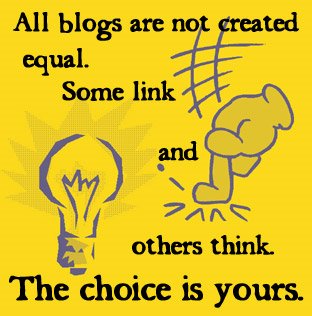
The vacuous reality of the blogosphere can be summed in a nice aphormism: there are those who link and those who think. Glenn Renolds’ Instapundit, for example, embodies the analysis-free "linking platform," updated about a ten thousand times a day, that dominates the blogosphere. This logorrhea and emptiness is useful as a filtration device for distilling what is valuable within the contours of the web, but it is a rambling, pitiful excuse for political insight. Blogs that do provide sincere thought are too often amateurish and insignificant, and, regardless, recieve far fewer visitors. The fuzzy feeling enjoyed when one conquers a 12 page Harper’s Magazine article, flowing with lapidary prose and delicately founded on well-contemplated analysis, is a warm satisfaction not often replicated in the blogosphere. Instead, you link to links that link to (presumably) more links.

However, the fact that blogs will never replace the Old Media misses the point. Democracy doesn’t necessitate editors or fact-checkers and it doesn’t guarantee quality on a microscale. Instead, it affords the eclectic and perhaps incendiary genius the voice to question the status quo – and his ideas to be scrutinized by the ubiquitous hands of public criticism. The blogger, uncontracted and unremunerated, can freely contribute his unique understandings, and the democractic dynamic thrives. Sure, the voice worth hearing might be quite rare – but with 10 million blogs and a great many more soon to come, that’s a risk I’m willing to take.

If you can stomach more blog self-contemplation, check out: In Defense of Internet Speech

Sunday, May 14, 2006

Update, Long Overdue

Just recently I escaped a two-week long pedagogic torture session, affectionately know to me and my peers as “AP week.” Basically, I’ve been studying a lot and stressing out even more. As such, I’ve let this site descend into a period that can only accurately be described with one word: stagflation.

Yes, of course, that’s not the only word I could use, but it’s certainly the most ridiculous, and therefore most appropriate. Luckily for you (and no less for me) APs are over and I can begin to pick up the pieces. I’m currently working on a number of projects that require investigation into a wide spectrum of American culture and politics: unequal education opportunities, immigration, evolutionary projections on society, modern racial tensions, and the spirit of terrorism, to name a few. This research will no doubt necessitate updates, so do check on occasion.

I have a sneaking suspicion that this site is becoming increasingly irrelevant. So, in an effort to win the readership of all those metropolitan youngsters and adults out there, I’ve decided to offer a simple media rating system. As you might suspect, my opinions on movies or, for that matter, anything cultural, are uninformed and essentially valueless. In life, it’s important to separate facts and moods. The former is eternal and unchanging; the latter is vain and temporary. I’ve made no attempt to separate the two in this rating system.

Sunday, March 26, 2006

In Defense of Internet Speech


“I don’t trust those blogs,” my English teacher defiantly remarked the other day. Emphasis on the word blog, as if the name itself were something obscene. Did she just say what I think she said? My heart began to pump a little louder. Sweat began to accumulate on my forehead. “They’re just not reputable,” she admonished in a you-crazy-teenager voice of skepticism. Yep, the earth-shattering declaration of unreliability was made. The trump card was played. "It’s simply unsanitary to associate with the plebeian multitude -- to peer into the cacophonous chamber of unfettered free-speech that is the internet 2.0," she seemed to suggest. I practically died right then and there of a coronary thrombosis of the most anxious degree.

Despite the pompous Parthian shot to my fragile ego -- and the ensuing panic attack -- I have to admit that her fear is not altogether irrational. As a species designed to operate on an individual level, we like to believe that an intelligent referee is monitoring the veracity of the media we digest. We like to believe that every piece of information is fact-checked, impartial, and wrapped in a pretty bow. We like to have faith in those above us and in those around us. To the dismay of many, the blogosphere, on the other hand, is not monitored, not refereed, and not fact-checked. Instead, it is what I consider to be the paradigmatic uninhibited marketplace of ideas. It is the ultimate forum for freedom of speech and for the democracy of thought so vital to our survival as a society.

What makes us uncomfortable about Wikipedia, Google, and the blogosphere, is that our brains were not designed to conceptualize the whole at the expense of the part. We are fixated on individual reliability (Is this article accurate? Is this reporter accredited? Is this book on Oprah’s book list?) at the price of large-scale optimization.

Wikipedia, on the other hand, uses the reverse logic: It sacrifices a little bit of accuracy on the microscale for a whole lot of efficiency on the macroscale. This is the concept of probabilistic statistics. In the world of the internet, information is emergent: an invisible hand steers the flow of ideas and information, sifting the good towards the top, and the bad towards the bottom. In the backwards entropy of our democracy, our economy, our evolution, and our internet, chaos on the individual level comes together to form a coherent whole. The whole is stronger than sum of the individual parts.

Therefore, Encyclopedia Encarta’s biggest flaw isn’t accuracy (although we give it more credit than it deserves), it’s omission. Despite sloppiness on the microscale, Wikipedia will excel over time by amassing greater and greater quantities of data, and higher and higher concentrations of the world’s information supply. Encarta will inch forward. Today, Wikipedia’s 1,045,000 articles absolutely eclipse Encarta’s meager 40,000. Tomorrow, the gap will only widen.

A free market place of ideas provides a breadth and depth of information unimaginable to the intellectual plutocracy that edits the mainstream media. Sure, no one blog post or one Wikipedia entry is authoritative, but their function is not as the ultimate ends for accuracy, but as the means for the probabilistic emergence of the world’s collective intelligence.

Monday, April 18, 2005

Note to Reader

Dear faithful The Liberal Conviction reader:
My Mock Trial team has just recently finished their championship match and I hope the relative stagnation of my blog will soon end, god willing (wait, this blog is strictly secular, scratch that). In the mean time, if anyone wants to contribute any articles, I would greatly appreciate it. In fact, I'm looking for a coauthor to pick up the slack when external pressures are building up, so if anyone is interested, you can email me (see side column). Obviously, as a student, from time to time school will take precedent, so an extra writer would certainly do some good.

Tuesday, February 08, 2005

The Liberal Conviction

It is my strong belief that the Democrats of the future will not cloak their beliefs in ambiguity in order to attain mass appeal; instead, the liberals of the future will clearly define what it means to be a Democrat. The Liberal Conviction is my humble attempt at the interpretation of modern liberalism and how a strong conviction of liberal principles equates to defining the actions of the Democratic Party. Rather than merely a group of un-unified factions, the Democratic Party of the future will be seen as a pervasive movement towards civil liberty, mandated legal equality, and universal humanity. As Woodrow Wilson once said, “I’d rather lose a battle that I’d eventually win, than win a battle I’d eventually lose”